
Sisl
Electronic structure Python package for post analysis and large scale tight-binding DFT/NEGF calculations
Overview
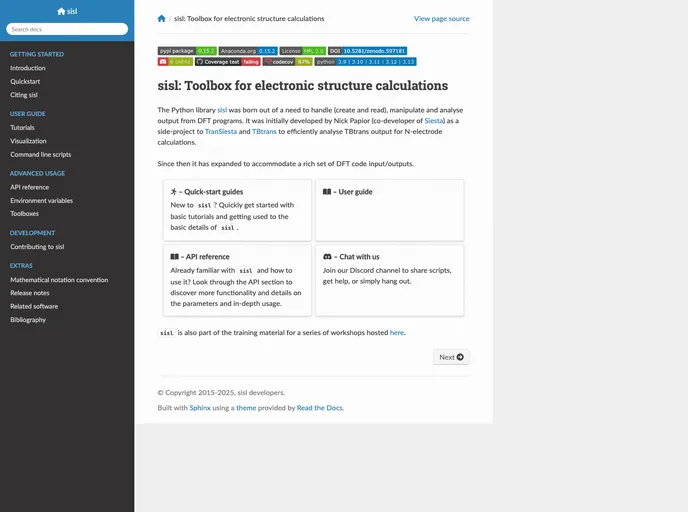
sisl is an open-source density functional theory API framework designed for post-analyzing output from density functional theory codes and conducting tight-binding calculations. The framework is versatile as it integrates with various density functional theory codes and has a strong connection with LCAO codes like Siesta. sisl stands out with its support for non-equilibrium Green function calculations using TBtrans as a backend.
Features
- Simple command-line interface: Extract or plot calculation outputs efficiently.
- Tight-binding API: Easy creation of tight-binding matrices for electronic structure analysis.
- Manipulation of sparse matrices: Extract, replace, append matrices, and sub-matrices seamlessly.
- Post-analyze DFT simulations: Conduct density of states, inverse participation ratio, and more on LCAO Hamiltonians.
- Post-analyze NEGF simulations: Create and analyze NEGF outputs effectively with TBtrans.
- Real-space grid analysis: Perform operations on DFT real-space grid outputs.
- Conversion of geometries and real-space grid: Convert geometry files and real-space grid file formats easily.
- User-contributed toolboxes: Share methodologies through contributed toolboxes.
- Interoperability with other codes: Seamless integration with ASE and pymatgen.
Summary
sisl is a powerful framework for post-analyzing density functional theory outputs and conducting tight-binding calculations. With features like a simple command-line interface, manipulation of sparse matrices, and interoperability with other codes, sisl offers a comprehensive solution for researchers in the field of computational materials science.
- Gulp

Gulp.js is an old but popular site building tool that automates various repetitive development tasks in web development, such as compiling Sass, minifying JavaScript, and optimizing images.