
Yamada Docs
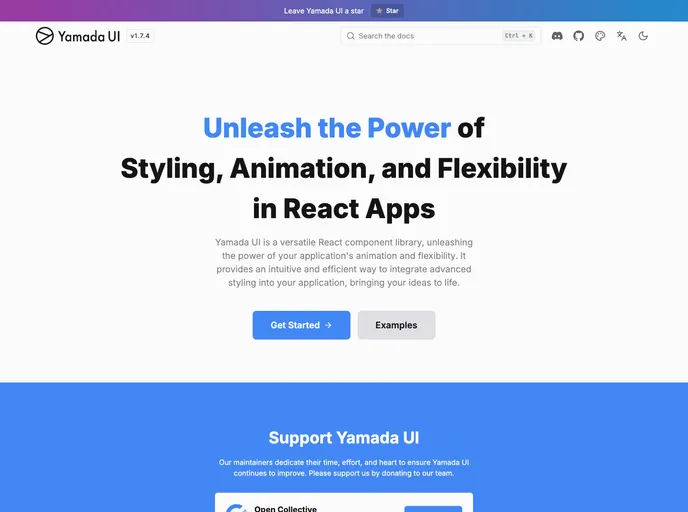


React UI components of the Yamada, by the Yamada, for the Yamada built with React and Emotion.
Overview:
Yamada UI is a React UI component library designed to simplify the development of advanced web applications and websites. It offers a wide array of components that can be effortlessly integrated to create intricate user interfaces, incorporating unique features like color modes and animations that are not commonly found in other React UI libraries.
Features:
- Ease of Styling: Includes layout components like Box and Stack for easy styling by passing props.
- Flexible & Composable: Built on React UIPrimitive for endless composability.
- Animation: Provides hooks for simple declaration of animations, akin to CSS animations, supported by all components.
- Color Mode: Enables setting values for each color mode in component props, a feature not found in other React UI libraries.
- Theme Switching: Allows users to easily switch themes and customize their own for web applications and websites.
- Other Features: Essential loading and notification features crucial for modern web applications are included, eliminating the need for individual definitions.
Summary:
Yamada UI is a feature-rich React UI component library that provides developers with essential tools to create advanced web applications and websites efficiently. With unique features like color modes, theme switching, and easy animation declarations, Yamada UI stands out among other React UI libraries. Its ease of styling and composability make it an attractive choice for developers looking to streamline their UI development process.
- Next.js
Next.js is a React-based web framework that enables server-side rendering, static site generation, and other powerful features for building modern web applications.
- React
React is a widely used JavaScript library for building user interfaces and single-page applications. It follows a component-based architecture and uses a virtual DOM to efficiently update and render UI components
- UI Kits & Components

A UI kit provides developers with a set of reusable components that can be easily integrated into a website or application. These components are pre-designed with consistent styling and functionality, allowing developers to save time and effort in the design and development process. UI kits can be either custom-built or third-party, and often include components for buttons, forms, typography, icons, and more.
- Contentlayer

Contentlayer is an open-source platform for building dynamic, data-driven websites and applications using markdown files as the content source. It features an intuitive API, flexible content modeling, and easy integration with popular frontend frameworks and tools.
- Dark Mode
Dark mode is a user interface option that uses a dark color scheme instead of light. It reduces eye strain and improves visibility in low-light conditions. Implementing dark mode in a website or application involves updating the styles and color palette to support both light and dark modes.
- Eslint

ESLint is a linter for JavaScript that analyzes code to detect and report on potential problems and errors, as well as enforce consistent code style and best practices, helping developers to write cleaner, more maintainable code.
- Framer Motion

Alpine.js is a lightweight JavaScript framework that simplifies the process of creating dynamic, reactive user interfaces on the web. It uses a declarative syntax that offers a higher level of abstraction compared to vanilla JavaScript, while being more performant and easier to use than jQuery.
- Typescript

TypeScript is a superset of JavaScript, providing optional static typing, classes, interfaces, and other features that help developers write more maintainable and scalable code. TypeScript's static typing system can catch errors at compile-time, making it easier to build and maintain large applications.