
Sample Nextjs Chakra Gallery App
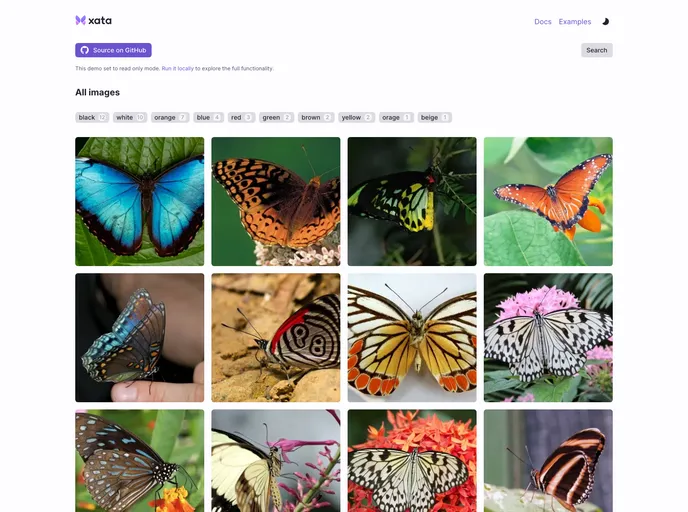


Gallery application built with Xata, Next.js and Chakra UI
Overview:
The Xata Gallery app is a small example application built with Next.js and Chakra UI. It showcases several features of the Xata database, including offset-based pagination, form management and submission, search, aggregations, image transformations, queries using junction tables and links, and proper Next.js + Xata TypeScript patterns. The app allows users to view a gallery of images and interact with them.
Features:
- Offset Based Pagination: Allows users to navigate through the gallery by loading a specific number of images at a time.
- Form Management and Submission: Users can submit forms to add new images to the gallery.
- Search: Provides a search functionality that allows users to search for specific images.
- Aggregations: Supports aggregating data to provide meaningful summaries or statistics about the images in the gallery.
- Image Transformations: Allows users to apply transformations to images, such as resizing or cropping.
- Queries using Junction Tables and Links: Enables complex queries using junction tables and links to efficiently retrieve related data.
- Proper Next.js + Xata TypeScript Patterns: Follows best practices for using Next.js and Xata together, ensuring a robust and scalable application.
Summary:
The Xata Gallery app is a demonstration of the capabilities of the Xata database, showcasing various features such as pagination, form management and submission, search, aggregations, image transformations, and complex queries. By following the provided installation guide, users can run the app locally and explore its functionality.
- Next.js
Next.js is a React-based web framework that enables server-side rendering, static site generation, and other powerful features for building modern web applications.
- React
React is a widely used JavaScript library for building user interfaces and single-page applications. It follows a component-based architecture and uses a virtual DOM to efficiently update and render UI components
- Chakra UI
Chakra UI is a popular open-source React component library that provides a set of accessible and customizable UI components to help developers create modern web applications.
- Eslint

ESLint is a linter for JavaScript that analyzes code to detect and report on potential problems and errors, as well as enforce consistent code style and best practices, helping developers to write cleaner, more maintainable code.
- Framer Motion

Alpine.js is a lightweight JavaScript framework that simplifies the process of creating dynamic, reactive user interfaces on the web. It uses a declarative syntax that offers a higher level of abstraction compared to vanilla JavaScript, while being more performant and easier to use than jQuery.
- Typescript

TypeScript is a superset of JavaScript, providing optional static typing, classes, interfaces, and other features that help developers write more maintainable and scalable code. TypeScript's static typing system can catch errors at compile-time, making it easier to build and maintain large applications.