
Modal
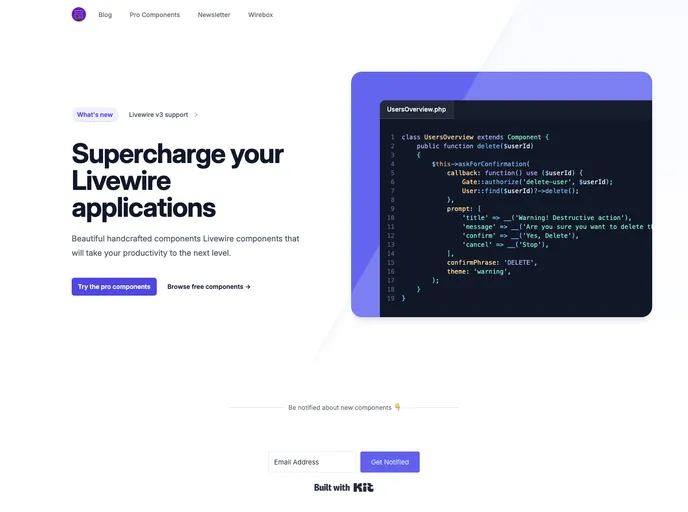


Livewire component that provides you with a modal that supports multiple child modals while maintaining state.
Overview
Livewire v3 introduces a revamped modal component, Wire Elements Modal, designed to enhance user experience with improved functionality. This new iteration allows developers to effortlessly manage multiple child modals while maintaining their state, making it a powerful tool for interactive applications. Upgrading from v2 is straightforward, requiring a few changes to adhere to the new conventions, ensuring a seamless transition.
The new features greatly improve the way developers can interact with modals, making the process of creating, opening, and closing modals more intuitive. This modal is optimized to work with TailwindCSS out of the box but can be customized for use with other CSS frameworks, giving developers flexibility in design.
Features
-
Multiple Child Modals: Wire Elements Modal supports the creation of multiple child modals, allowing for a more complex and interactive UI without losing state.
-
Seamless Upgrade: The upgrade process from Livewire v2 is automated through a command, simplifying the transition and ensuring compliance with new naming conventions.
-
Easy Integration: Installation is hassle-free with Composer. Simply require the package and use the @livewire directive to drop the modal into your templates.
-
Dynamic Parameter Passing: Modal components can dynamically fetch models from the database through parameters, streamlining data handling and interactions.
-
Event Dispatching: Modals can be opened and closed using events, giving developers control over modal interactions and allowing for a fluid user experience.
-
Customizable Modal Properties: Modify modal attributes such as width directly within the component class, ensuring the component fits design needs.
-
TailwindCSS Compatibility: The base modal is designed with TailwindCSS in mind, promoting responsive design and easy styling.
-
Event Handling: Close modals and update other Livewire components using methods like closeModalWithEvents, ensuring the UI reflects changes in real-time.
- Laravel
Laravel is a powerful and elegant PHP framework that provides developers with a comprehensive set of tools and features to build robust web applications. It follows the Model-View-Controller (MVC) architectural pattern, offering a clean and organized structure for writing efficient and maintainable code.
- Tailwind
Tailwind CSS is a utility-first CSS framework that provides pre-defined classes for building responsive and customizable user interfaces.
- Postcss
PostCSS is a popular open-source tool that enables web developers to transform CSS styles with JavaScript plugins. It allows for efficient processing of CSS styles, from applying vendor prefixes to improving browser compatibility, ultimately resulting in cleaner, faster, and more maintainable code.