
Onborda
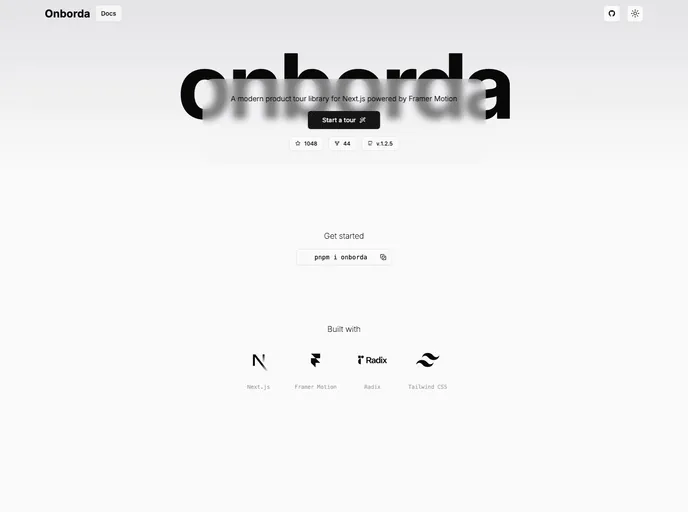



An onboarding wizard flow / product tour for Next.js animated by framer motion
Overview
Onborda is a lightweight onboarding flow designed using Next.js with framer-motion for animations and tailwindcss for styling. It features fully customizable tooltips and supports the option to create multiple product tours. The tool offers a Global layout.tsx and Components & page.tsx for easy integration into modern web applications.
Features
- Customizable Pointers: Easily customize tooltips for modern web applications.
- Tailwind CSS Integration: Utilizes tailwindcss for styling with customizable configurations.
- Support for Multiple Product Tours: Create and manage multiple tours with diverse content and designs.
- Next.js Compatibility: Designed using Next.js for seamless integration and enhanced performance.
- Framer-motion Animations: Incorporates framer-motion for dynamic and engaging animations.
- Global Layout Component: Offers a Global layout.tsx for consistent design and layout throughout the application.
- Component Flexibility: Easily target specific elements using the elements id attribute for enhanced control.
Summary
Onborda is a versatile onboarding tool that offers a wide range of features for creating engaging and customizable onboarding experiences. With support for multiple product tours, integration with Next.js, and tailwindcss styling, Onborda provides a comprehensive solution for modern web applications. Its compatibility with framer-motion adds dynamic animations, while the Global layout component ensures consistency in design. The tool's focus on customization and flexibility makes it a valuable asset for developers looking to enhance user onboarding processes.
- Next.js
Next.js is a React-based web framework that enables server-side rendering, static site generation, and other powerful features for building modern web applications.
- React
React is a widely used JavaScript library for building user interfaces and single-page applications. It follows a component-based architecture and uses a virtual DOM to efficiently update and render UI components
- Tailwind
Tailwind CSS is a utility-first CSS framework that provides pre-defined classes for building responsive and customizable user interfaces.
- Shadcn UI
Beautifully designed components that you can copy and paste into your apps. Accessible. Customizable. Open Source.
- Framer Motion

Alpine.js is a lightweight JavaScript framework that simplifies the process of creating dynamic, reactive user interfaces on the web. It uses a declarative syntax that offers a higher level of abstraction compared to vanilla JavaScript, while being more performant and easier to use than jQuery.
- Typescript

TypeScript is a superset of JavaScript, providing optional static typing, classes, interfaces, and other features that help developers write more maintainable and scalable code. TypeScript's static typing system can catch errors at compile-time, making it easier to build and maintain large applications.