
React Notifications
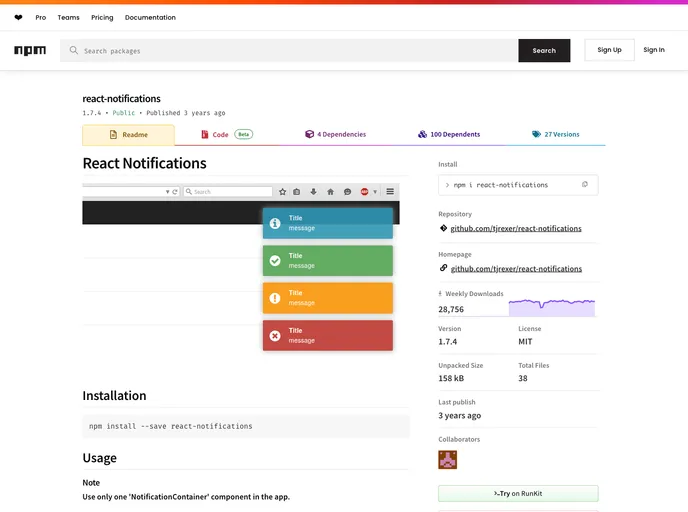




Notification component for ReactJS
Overview
React Notifications is a useful library designed to enhance the user experience by providing a mechanism for displaying notifications in a React application. With its straightforward API and customizable features, it allows developers to seamlessly integrate notifications into their projects, adding an important layer of user interaction. The ability to showcase different notification types—such as success, warning, and error—ensures that developers can effectively communicate various messages to users.
Built around a simple yet effective approach, React Notifications promotes clean code practices and encourages good UI design. It offers flexibility in terms of timeout settings, message priorities, and callback functionalities, making it an attractive option for web developers looking to enrich their applications.
Features
-
Single NotificationContainer: The library encourages the use of only one 'NotificationContainer' component per app, streamlining management and organization of notifications.
-
Custom Timeout Settings: The
enterTimeoutandleaveTimeoutproperties can be adjusted for smoother animations, enhancing the visual appeal of notifications. -
Diverse Notification Types: Support for multiple notification types—info, success, warning, and error—ensures users receive contextually relevant messages.
-
Custom Callbacks: Implement a callback function that executes upon user interaction with the notification, allowing for additional actions like navigating or triggering events.
-
Dynamic Message Display: With the
priorityproperty, important messages can be pushed to the top, ensuring critical information catches the user's attention first. -
Adaptable Axios Support: The library is designed to work seamlessly with applications built in various setups, including CSS, Webpack, and UMD formats, providing versatility in integration options.
-
Active Community: A clear contribution workflow encourages collaboration, making it easier for developers to suggest improvements and enhancements to the library.
- Express
Express.js is a simple Node.js framework for single, multi-page, and hybrid web applications.
- React
React is a widely used JavaScript library for building user interfaces and single-page applications. It follows a component-based architecture and uses a virtual DOM to efficiently update and render UI components
- Bootstrap
Bootstrap is the most popular CSS Framework for developing responsive and mobile-first websites.
- SCSS
SCSS is a preprocessor scripting language that extends the capabilities of CSS by adding features such as variables, nesting, and mixins. It allows developers to write more efficient and maintainable CSS code, and helps to streamline the development process by reducing repetition and increasing reusability.
- Eslint

ESLint is a linter for JavaScript that analyzes code to detect and report on potential problems and errors, as well as enforce consistent code style and best practices, helping developers to write cleaner, more maintainable code.
- Gulp

Gulp.js is an old but popular site building tool that automates various repetitive development tasks in web development, such as compiling Sass, minifying JavaScript, and optimizing images.
- Webpack

Webpack is a popular open-source module bundler for JavaScript applications that bundles and optimizes the code and its dependencies for production-ready deployment. It can also be used to transform other types of assets such as CSS, images, and fonts.