
UI
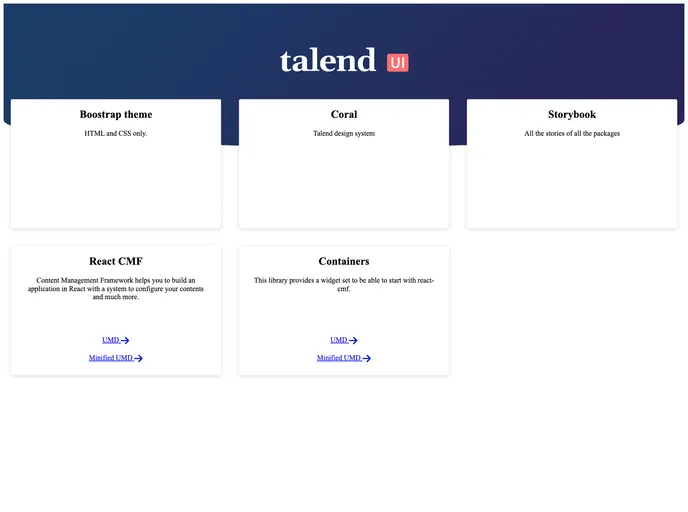

Talend's unified web UI repository.
Overview
The UIThat repository is a groundbreaking initiative aimed at streamlining the development process of Talend's front-end stack. By consolidating multiple packages into a single repository, it facilitates efficient management and enhances collaboration among developers. This innovative approach not only simplifies code maintenance but also fosters a community-driven spirit where open-source contributions can thrive.
With a focus on creating a stable and scalable stack, UIThat leverages various tools and features to ensure a seamless development experience. It emphasizes cross-package development, testing, and review processes, making it easier for developers to implement changes while maintaining robustness in the API and overall project integrity.
Features
-
Single Code Repository: Consolidates multiple packages into one, simplifying the overall development workflow for front-end projects.
-
Global Testing Tools: Offers shared testing and review tools that enhance the quality assurance process across all packages.
-
Easy Cross-Package Development: Facilitates seamless integration between different packages, enabling developers to work more efficiently.
-
CI Integration: Ensures that tests and linting checks pass before merging pull requests, helping maintain code quality and stability.
-
Demo Provisioning: Automatically generates a demo for reviewers to interact with changes, allowing for thorough validation and feedback.
-
Version Management: Utilizes changesets for reliable versioning and automated changelog updates with each pull request.
-
Stability Focus: Commits to maintaining API stability, minimizing breaking changes and ensuring a smoother development process.
This comprehensive feature set makes UIThat an essential tool for developers looking to optimize their front-end stack while embracing the open-source community.
- React
React is a widely used JavaScript library for building user interfaces and single-page applications. It follows a component-based architecture and uses a virtual DOM to efficiently update and render UI components
- Eslint

ESLint is a linter for JavaScript that analyzes code to detect and report on potential problems and errors, as well as enforce consistent code style and best practices, helping developers to write cleaner, more maintainable code.
- Typescript

TypeScript is a superset of JavaScript, providing optional static typing, classes, interfaces, and other features that help developers write more maintainable and scalable code. TypeScript's static typing system can catch errors at compile-time, making it easier to build and maintain large applications.