
Surely Table
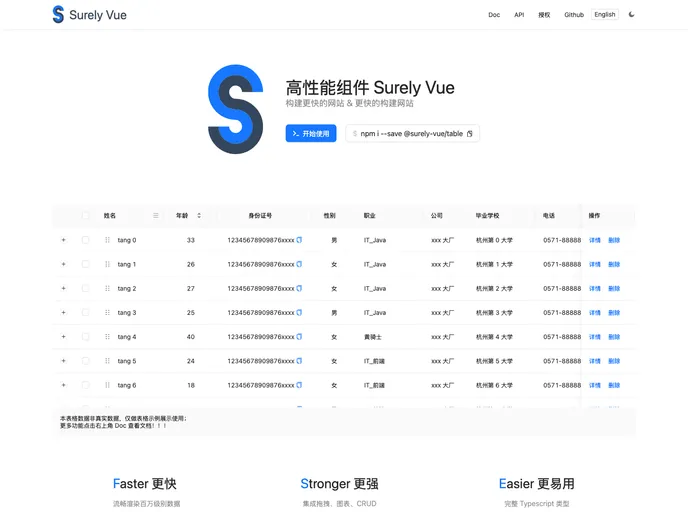




Performant advanced table component
Overview:
Surely Vue Table is a sophisticated component developed by the Ant Design Vue team, designed to tackle the challenges of rendering large datasets and integrating charts. This component allows for smooth scrolling through massive amounts of data—up to 100,000 rows and columns—ensuring that users experience no lag or performance issues that could lead to complaints and hinder business progress. While it has been developed by the Ant Design Vue team, it can be used across any component library, not just those within the Ant Design ecosystem.
One of the key highlights of Surely Vue is its default virtual scrolling feature, which significantly enhances rendering speeds. The component supports a wide array of functionalities such as tree data, expandable content, nested tables, row and column merging, and various scrolling options. Although it operates on a commercial model, it remains accessible for free, albeit with a watermark. The team behind Surely Vue aims to strike a balance between open-source principles and sustainable business practices to foster continuous growth and innovation.
Features:
- High Performance: Handles up to 100,000 rows and columns seamlessly with virtual scrolling to eliminate performance issues.
- Customizable Cells: Allows for custom cell styles and row styling to suit the specific needs of complex datasets.
- Advanced Sorting Options: Supports single and multiple column sorting along with server-side sorting capabilities.
- Flexible Filtering: Provides built-in and customizable filtering options to help manage large volumes of data effectively.
- Sticky Headers and Columns: Features fixed headers and columns for easier navigation through extensive data tables.
- Dynamic Pagination: Offers pagination solutions, including custom pagination options to enhance data management.
- Tree and Nested Data Support: Capable of displaying hierarchical data structures and includes features for nesting tables.
- Dark Mode Availability: For users who prefer a different aesthetic, it supports dark mode for a modern look and user experience.
- Vite
Vite is a build tool that aims to provide a faster and leaner development experience for modern web projects
- Vue
Vue.js is a lightweight and flexible JavaScript framework that allows developers to easily build dynamic and reactive user interfaces. Its intuitive syntax, modular architecture, and focus on performance make it a popular choice for modern web development.
- LESS
Less CSS is a dynamic stylesheet language that extends the capabilities of CSS, allowing developers to write cleaner, more modular, and reusable stylesheets with features like variables, mixins, and nested rules.
- UnoCSS
UnoCSS is an instant, on-demand atomic CSS engine that generates utility classes at build time. It's highly customizable, extremely fast, and compatible with Tailwind CSS utilities while offering additional features like attributify mode and pure CSS icons.
- Eslint

ESLint is a linter for JavaScript that analyzes code to detect and report on potential problems and errors, as well as enforce consistent code style and best practices, helping developers to write cleaner, more maintainable code.
- Gulp

Gulp.js is an old but popular site building tool that automates various repetitive development tasks in web development, such as compiling Sass, minifying JavaScript, and optimizing images.
- Postcss

PostCSS is a popular open-source tool that enables web developers to transform CSS styles with JavaScript plugins. It allows for efficient processing of CSS styles, from applying vendor prefixes to improving browser compatibility, ultimately resulting in cleaner, faster, and more maintainable code.
- Prism JS

PrismJS is an open-source, lightweight, and extensible syntax highlighting library that supports a wide range of programming languages and markup formats.
- Rollup

RollupJS is a popular and efficient JavaScript module bundler that takes the code from multiple modules and packages them into a single optimized file, minimizing the overall size of the application and improving its performance.
- Typescript

TypeScript is a superset of JavaScript, providing optional static typing, classes, interfaces, and other features that help developers write more maintainable and scalable code. TypeScript's static typing system can catch errors at compile-time, making it easier to build and maintain large applications.