
NgTemplateOutlets
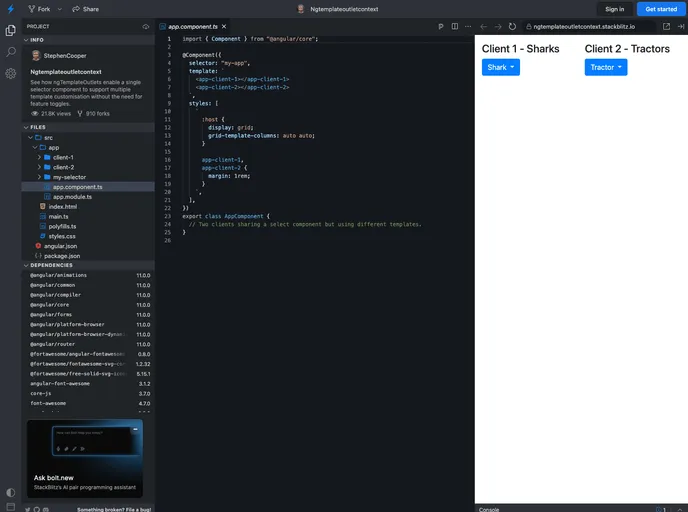

Code to demonstrate how to use ngTemplateOutlet, along with ngTemplateOutletContext, to make a component completely customisable.
## Overview
The ngTemplateOutlets feature is a powerful capability in Angular that enhances the flexibility of component templating. It allows developers to leverage a single selector component while supporting multiple template customizations, which can greatly simplify managing different UI variations without resorting to feature toggles. This innovation opens up new possibilities for creating dynamic and adaptable user interfaces in web applications.

## Features
- **Dynamic Template Rendering**: ngTemplateOutlets allows for the rendering of different templates at runtime, providing the ability to switch between UI representations easily based on application states or user actions.
- **Single Selector Component**: This feature enables developers to utilize a unique selector for a component, reducing the complexity associated with multiple components or feature toggles.
- **Easily Customizable**: With ngTemplateOutlets, custom templates can be injected into a component seamlessly, allowing for an easy and clean way to enhance component functionality.
- **Enhanced Code Reusability**: By centralizing the component logic while varying the templates, ngTemplateOutlets promotes code reuse, making it easier to maintain and scale applications.
- **Support for Multiple Contexts**: The feature supports various contexts, meaning different data can be passed to the templates for rendering, enhancing versatility in UI presentation.
- **Simplified Maintenance**: With a robust structure to handle multiple templates, maintaining the codebase becomes less cumbersome as only a single component requires updates or modifications.
- Angular
Angular is a TypeScript-based open-source framework by Google for building dynamic single-page applications and cross-platform mobile apps with MVC architecture and a rich set of features.
- Typescript

TypeScript is a superset of JavaScript, providing optional static typing, classes, interfaces, and other features that help developers write more maintainable and scalable code. TypeScript's static typing system can catch errors at compile-time, making it easier to build and maintain large applications.