
11st Starter Kit
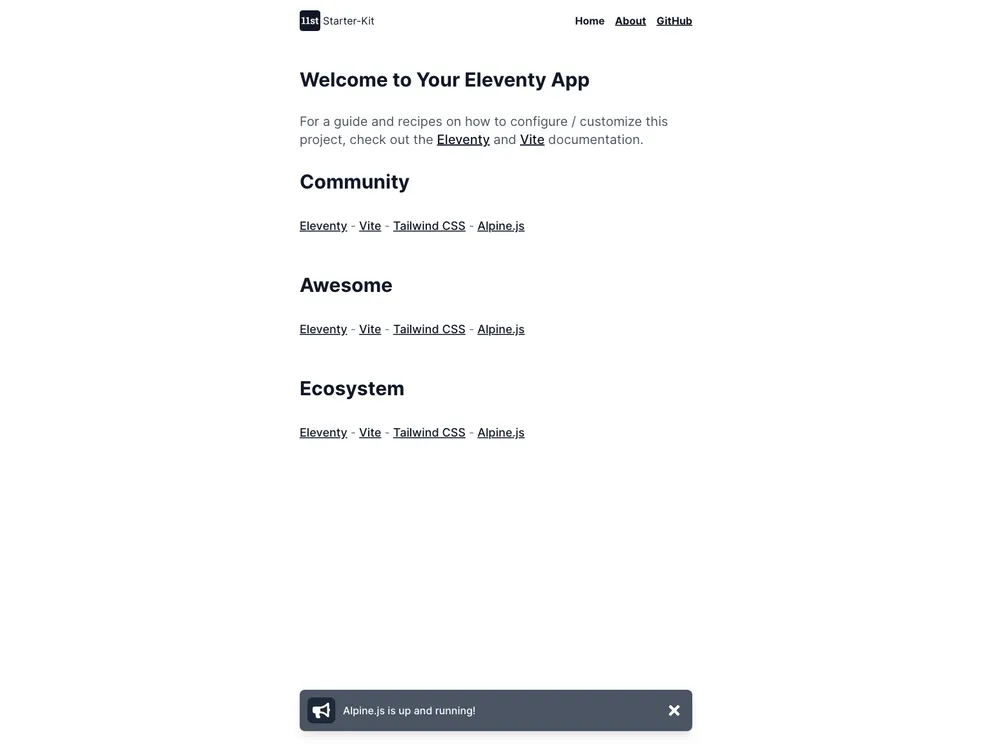




11ty, powered by Vite with Tailwind CSS and Alpine.js.
Overview:
The 11st-Starter-Kit is a web development project that combines 11ty, Vue.js, Tailwind CSS, and Alpine.js. It provides a comprehensive set of features and tools to quickly set up and deploy websites. The project is open source and available under the MIT License.
Features:
- 11ty: A static site generator that allows for the creation of static websites.
- Vue.js: A JavaScript framework for building user interfaces.
- Tailwind CSS: A utility-first CSS framework that provides a wide range of pre-designed components and utility classes.
- Alpine.js: A lightweight JavaScript framework for building interactive web interfaces.
Summary:
The 11st-Starter-Kit is a versatile web development project that combines the power of 11ty, Vue.js, Tailwind CSS, and Alpine.js. It provides an easy-to-use framework for building static websites with a wide range of pre-designed components and utility classes. The project is open source and available under the MIT License, allowing developers to customize and modify it to suit their specific needs.
- Eleventy
11ty is a static site generator that allows developers to build fast, modern websites using HTML, Markdown, and other templating languages, without the need for a complex build system.
- Vite
Vite is a build tool that aims to provide a faster and leaner development experience for modern web projects
- Tailwind
Tailwind CSS is a utility-first CSS framework that provides pre-defined classes for building responsive and customizable user interfaces.
- Alpine.js
Alpine.js is a lightweight JavaScript framework that simplifies the process of creating dynamic, reactive user interfaces on the web. It uses a declarative syntax that offers a higher level of abstraction compared to vanilla JavaScript, while being more performant and easier to use than jQuery.
- Eslint

ESLint is a linter for JavaScript that analyzes code to detect and report on potential problems and errors, as well as enforce consistent code style and best practices, helping developers to write cleaner, more maintainable code.
- Netlify

Netlify is a cloud-based web development platform that provides a range of tools and services to help developers build, deploy, and manage modern web applications. It offers features such as continuous deployment, serverless functions, and CDN hosting, making it an ideal platform for building fast, scalable, and secure websites.
- Postcss

PostCSS is a popular open-source tool that enables web developers to transform CSS styles with JavaScript plugins. It allows for efficient processing of CSS styles, from applying vendor prefixes to improving browser compatibility, ultimately resulting in cleaner, faster, and more maintainable code.
- Pwa
A Progressive Web App (PWA) is a type of web application that uses modern web technologies to provide a native app-like experience to users, including offline functionality, push notifications, and device hardware access. PWAs can be installed on a user's home screen and launched like a traditional app, but do not require a separate app store listing or download.
- Stylelint
Stylelint is a modern linter for CSS that helps you avoid errors and enforce consistent styling conventions. It provides rules for detecting errors and warnings, and can be configured to match your specific project's requirements.