
Material
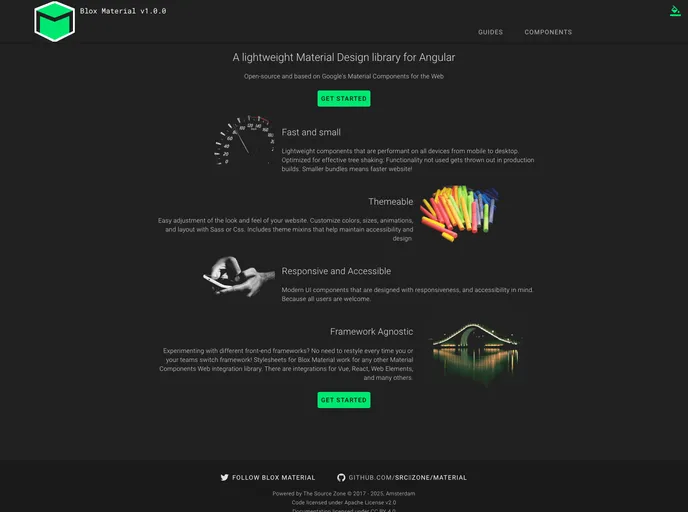

A lightweight Material Design library for Angular based on Google's Material Components for the Web.
Overview
Blox Material is an Angular library that allows users to develop visually appealing and easily customizable applications. It combines Material Components for the Web, a Google project, with the Angular framework. By adhering to the Material Design Guidelines, Blox Material ensures a consistent and intuitive user interface.
Features
- Modular and customizable UI components
- Integration of Material Components for the Web with Angular
- Support for Angular schematics
- Addition of new components such as banner, circular-progress, data-table, segmented-button, tooltip, and touch-target
- Alternative components for complex structure directives
- Autocomplete input component
Summary
Blox Material is a powerful Angular library that allows developers to easily create visually appealing applications by integrating Material Design Guidelines with the Angular framework. With its modular and customizable UI components, support for Angular schematics, and additional features such as autocomplete input and new components, Blox Material simplifies the process of building stunning web applications. By following the provided installation guide, developers can quickly set up and start using this feature-rich library.
- Angular
Angular is a TypeScript-based open-source framework by Google for building dynamic single-page applications and cross-platform mobile apps with MVC architecture and a rich set of features.
- UI Kits & Components

A UI kit provides developers with a set of reusable components that can be easily integrated into a website or application. These components are pre-designed with consistent styling and functionality, allowing developers to save time and effort in the design and development process. UI kits can be either custom-built or third-party, and often include components for buttons, forms, typography, icons, and more.
- Material Design

Material Design is a design system developed by Google that provides a set of guidelines, components, and tools for creating visually appealing and functional user interfaces. Material Design is designed to be flexible and customizable, making it a great choice for a wide range of applications and use cases.
- Typescript

TypeScript is a superset of JavaScript, providing optional static typing, classes, interfaces, and other features that help developers write more maintainable and scalable code. TypeScript's static typing system can catch errors at compile-time, making it easier to build and maintain large applications.