Nextjs Hashnode Blog
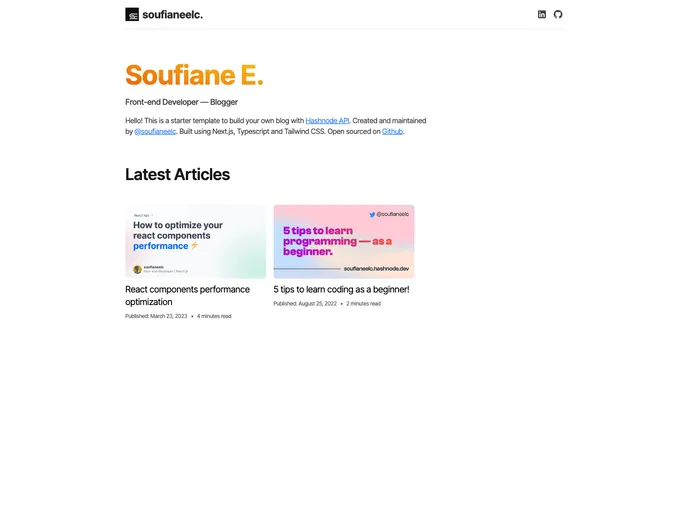


A Next.js blog template built on top of Hashnode API
Overview:
This product is a template for building a blog using Next.js, Tailwind CSS, TypeScript, and integrating with the Hashnode API for content management. It provides a clean and organized structure to help users kickstart their blogging journey.
Features:
- Next.js: The template is built using Next.js, a popular React framework that allows for server-side rendering and automatic code splitting.
- Tailwind CSS: The template utilizes Tailwind CSS, a highly customizable CSS framework that provides utility classes to style components.
- TypeScript: The template is written in TypeScript, a statically typed programming language that adds type safety to JavaScript.
- Hashnode API Integration: The template integrates with the Hashnode API for content management, allowing users to create and publish blog posts on their Hashnode account.
Summary:
This template provides a convenient starting point for building a blog using Next.js, Tailwind CSS, TypeScript, and Hashnode API integration. It offers key features such as server-side rendering, customizable styling with Tailwind CSS, and type safety with TypeScript. The template also provides instructions for customizing content, deploying the blog, and contributing to the project. Overall, it aims to simplify the process of setting up a blog and provides a solid foundation for customization and expansion.
- Next.js
Next.js is a React-based web framework that enables server-side rendering, static site generation, and other powerful features for building modern web applications.
- React
React is a widely used JavaScript library for building user interfaces and single-page applications. It follows a component-based architecture and uses a virtual DOM to efficiently update and render UI components
- Tailwind
Tailwind CSS is a utility-first CSS framework that provides pre-defined classes for building responsive and customizable user interfaces.
- Blog

Blog websites feature posts written by one or more authors, organized by categories and tags, with a section for comments and archives sorted by date or topic. Additional features may include search bar, social media sharing, subscription or RSS feed, about and contact pages, and visual content.
- Templates & Themes

A template or theme refers to a pre-designed layout or structure that provides a basic framework for building a specific type of application or website. It typically includes good design, placeholder content and functional features, allowing developers to customize and fill in the details according to their specific needs.
- MDX

MDX is a format that allows developers to write JSX within Markdown documents, combining the power of React with the simplicity of Markdown. This allows for the creation of dynamic and interactive content that can be easily shared and consumed across different platforms and devices.
- Postcss

PostCSS is a popular open-source tool that enables web developers to transform CSS styles with JavaScript plugins. It allows for efficient processing of CSS styles, from applying vendor prefixes to improving browser compatibility, ultimately resulting in cleaner, faster, and more maintainable code.
- Typescript

TypeScript is a superset of JavaScript, providing optional static typing, classes, interfaces, and other features that help developers write more maintainable and scalable code. TypeScript's static typing system can catch errors at compile-time, making it easier to build and maintain large applications.