
Remix Tutorial Yt
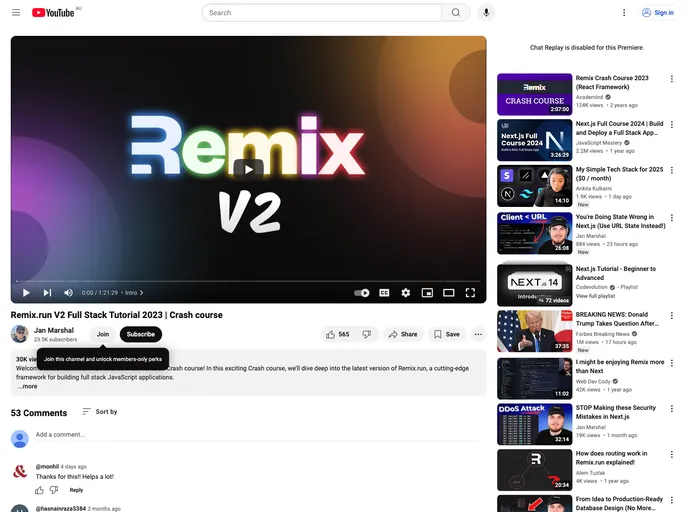



This is a tutorial I have created on Remix.run V2 in which I build a basic movie application
Overview:
Remix.run V2 is a full-stack framework and toolchain for building web applications. It provides developers with the ability to create high-performance websites, using modern technologies such as React, server-side rendering, and a powerful routing system. With Remix.run V2, developers can easily build and deploy their applications, without the need for complex setup or configuration.
Features:
- Remix.run V2 Full Stack Tutorial: A comprehensive tutorial that guides developers through the process of using Remix.run V2 to build a full-stack web application.
- Remix.run: The main component of the framework, Remix.run provides developers with the ability to build high-performance React applications with server-side rendering and a powerful routing system.
- Tailwind.css: The framework includes integration with Tailwind.css, a utility-first CSS framework that provides developers with a set of pre-designed components and styles.
- The Movie Database: Remix.run V2 includes integration with The Movie Database, allowing developers to easily access and display movie data in their applications.
- Trending Movies Docs: The framework provides comprehensive documentation on how to retrieve and display trending movies from The Movie Database API.
- Details Docs: Remix.run V2 documentation includes detailed guides on how to fetch and display movie details from The Movie Database API.
- Deployment: The framework supports deployment to various platforms, including Vercel. Developers can easily deploy their Remix.run V2 applications by importing their Git repository into Vercel.
Summary:
Remix.run V2 is a powerful full-stack framework that provides developers with the tools and features needed to build high-performance web applications. With its integration with Tailwind.css and The Movie Database, developers can easily create visually appealing and data-rich applications. The framework also offers seamless deployment options with Vercel, making it easy to deploy and host Remix.run V2 applications.
- React
React is a widely used JavaScript library for building user interfaces and single-page applications. It follows a component-based architecture and uses a virtual DOM to efficiently update and render UI components
- Tailwind
Tailwind CSS is a utility-first CSS framework that provides pre-defined classes for building responsive and customizable user interfaces.
- Prisma
Prisma is a server-side library that helps developers read and write data to the database in an intuitive, efficient and safe way.
- Fullstack

A fullstack boilerplate provides a starter application that includes both frontend and backend. It should include database, auth, payments, user roles and other backend services to build a fully featured saas or webapps.
- Eslint

ESLint is a linter for JavaScript that analyzes code to detect and report on potential problems and errors, as well as enforce consistent code style and best practices, helping developers to write cleaner, more maintainable code.
- Typescript

TypeScript is a superset of JavaScript, providing optional static typing, classes, interfaces, and other features that help developers write more maintainable and scalable code. TypeScript's static typing system can catch errors at compile-time, making it easier to build and maintain large applications.