
Next Firebase Starter
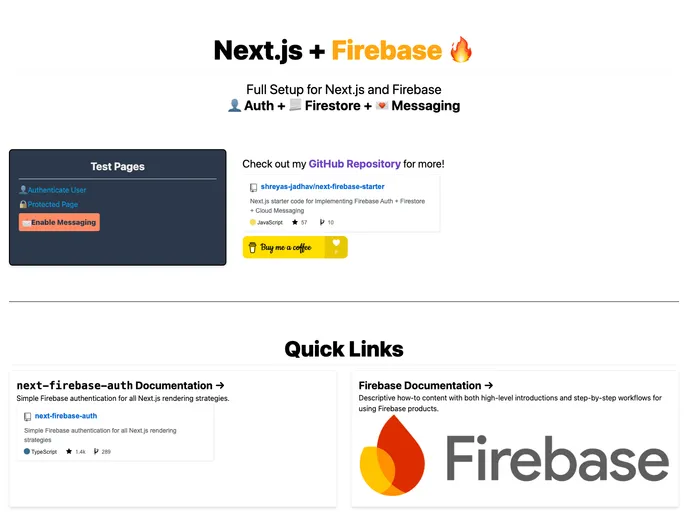


Next.js starter code for Implementing Firebase Auth + Firestore + Cloud Messaging
Overview
The Next.js + Firebase setup provides a robust and scalable framework for building modern web applications. By integrating Firebase authentication and Firestore with Next.js, developers can effortlessly create powerful applications that are both secure and efficient. This setup not only simplifies the initial configuration but also ensures that all essential features are in place, allowing for a smooth development experience. Whether you’re building a private dashboard or a full-fledged app, this starter code has everything you need to get started on the right foot.
The demo showcases the capabilities of this setup, highlighting how Next.js handles server-side rendering (SSR) and static site generation (SSG) using Firestore data. With Tailwind CSS for design flexibility and Firebase Cloud Messaging for real-time updates, this starter template is ideal for developers who want to leverage modern tech stacks while ensuring their applications are responsive and interactive.
Features
- Firebase Authentication Setup: Seamlessly integrates secure authentication methods for both private and public pages, enhancing user security and experience.
- User Collection Management: Automatically adds new users to the Firestore users collection upon registration, simplifying the user management process.
- SSR / SSG with Firestore Data: Utilizes server-side rendering and static site generation to fetch and display data efficiently, improving load times and SEO.
- Firebase Cloud Messaging: Enables real-time notifications through FCM, ensuring that users receive timely updates and alerts.
- Tailwind CSS Integration: Offers a clean and customizable design framework that allows for responsive styling without hassle.
- Module Path Aliases: Simplifies imports within your project with path aliases, improving code organization and readability.
- Custom Authentication Providers: Easily extend the authentication capabilities by adding custom providers, tailoring the user access methods to specific needs.
- Clean Project Structure: Maintains a well-organized file structure for better maintainability and scalability in future development.
- Next.js
Next.js is a React-based web framework that enables server-side rendering, static site generation, and other powerful features for building modern web applications.
- React
React is a widely used JavaScript library for building user interfaces and single-page applications. It follows a component-based architecture and uses a virtual DOM to efficiently update and render UI components
- Tailwind
Tailwind CSS is a utility-first CSS framework that provides pre-defined classes for building responsive and customizable user interfaces.
- Firebase
Firebase offers a comprehensive set of features, including real-time database, authentication, hosting, cloud functions, storage, and more. Firebase provides an easy-to-use interface and allows developers to focus on building features rather than managing infrastructure.
- Postcss

PostCSS is a popular open-source tool that enables web developers to transform CSS styles with JavaScript plugins. It allows for efficient processing of CSS styles, from applying vendor prefixes to improving browser compatibility, ultimately resulting in cleaner, faster, and more maintainable code.