
Launch Mvp Stripe Nextjs Supabase
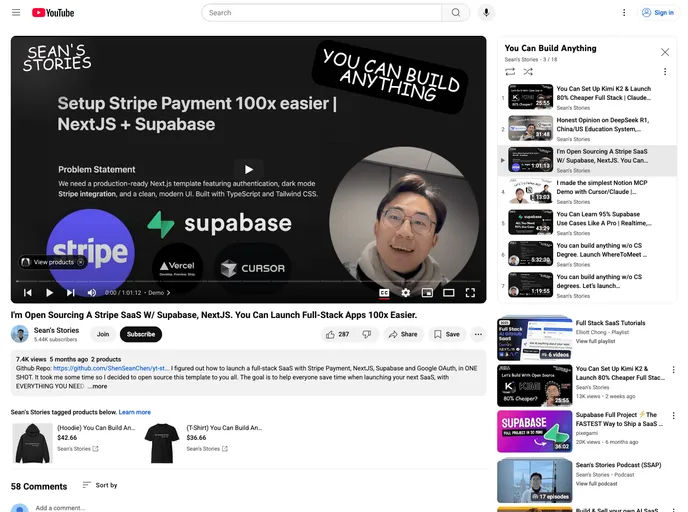


Welcome to Sean's Open Source MVP Boilerplate Template for Production-Ready NextJS+Stripe+Supabase App.
Overview
The Next.js + Stripe + Supabase Production-Ready Template is an innovative solution tailored for developers looking to build robust web applications with modern technologies. This template combines the powerful features of Next.js with the flexibility of Stripe for payments and Supabase for authentication and database management. With a clean and modern UI, this template not only simplifies the setup of web apps but also ensures a seamless user experience with features like dark mode support and responsive design.
Built using TypeScript and Tailwind CSS, the template emphasizes maintainability and aesthetics. It's suitable for both seasoned developers and newcomers aiming to integrate essential functionality into their projects quickly, leveraging the power of cloud technologies.
Features
- 🔐 Authentication with Supabase: Easily implement user authentication, providing security and seamless login experiences.
- 💳 Stripe Payment Integration: Simplify payment processes with built-in Stripe functionalities for subscriptions and one-time purchases.
- 🌓 Dark Mode Support: Automatic switching to dark mode ensures a comfortable viewing experience in low light conditions.
- 📱 Responsive Design: The template is designed to work flawlessly across various devices and screen sizes.
- 🎨 Tailwind CSS Styling: Utilize modern utility-first CSS styling for a visually appealing UI that is easy to customize.
- 🔄 Framer Motion Animations: Enhance the user experience with smooth animations that bring your application to life.
- 🛡️ TypeScript Support: Offers type safety and enhances the development process, making it easier to identify errors early on.
- 📊 Error Boundary Implementation: Improve application reliability by catching errors in UI components efficiently and providing user-friendly feedback.
- Next.js
Next.js is a React-based web framework that enables server-side rendering, static site generation, and other powerful features for building modern web applications.
- React
React is a widely used JavaScript library for building user interfaces and single-page applications. It follows a component-based architecture and uses a virtual DOM to efficiently update and render UI components
- Tailwind
Tailwind CSS is a utility-first CSS framework that provides pre-defined classes for building responsive and customizable user interfaces.
- Headless UI
Headless UI is a set of completely unstyled, fully accessible UI components for React, Vue, and Alpine.js that empower developers to build their own fully accessible custom UI components. Headless UI allows developers to focus on building accessible and highly functional user interfaces, without the need to worry about styling or layout.
- Eslint

ESLint is a linter for JavaScript that analyzes code to detect and report on potential problems and errors, as well as enforce consistent code style and best practices, helping developers to write cleaner, more maintainable code.
- Framer Motion

Alpine.js is a lightweight JavaScript framework that simplifies the process of creating dynamic, reactive user interfaces on the web. It uses a declarative syntax that offers a higher level of abstraction compared to vanilla JavaScript, while being more performant and easier to use than jQuery.
- Postcss

PostCSS is a popular open-source tool that enables web developers to transform CSS styles with JavaScript plugins. It allows for efficient processing of CSS styles, from applying vendor prefixes to improving browser compatibility, ultimately resulting in cleaner, faster, and more maintainable code.
- Typescript

TypeScript is a superset of JavaScript, providing optional static typing, classes, interfaces, and other features that help developers write more maintainable and scalable code. TypeScript's static typing system can catch errors at compile-time, making it easier to build and maintain large applications.