
Laravel Haystack

Supercharged job chains for Laravel
Overview
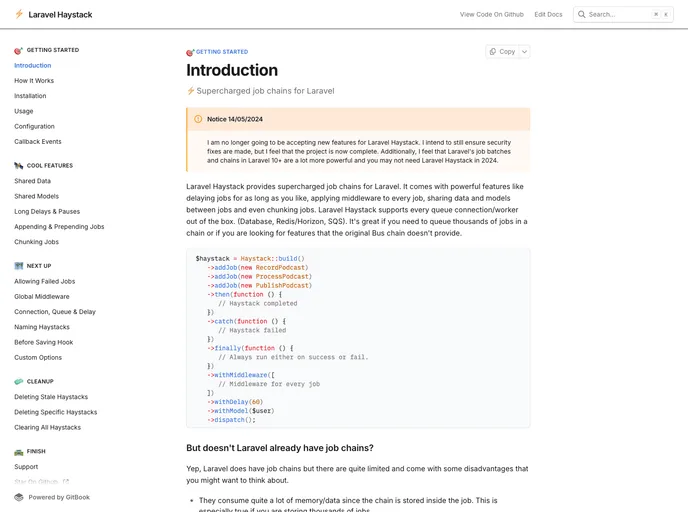
Laravel Haystack is a powerful tool designed for developers using Laravel who require advanced job chaining capabilities. As of May 2024, the creator has announced the project will no longer accept new features, as they believe it has reached a level of completeness, especially with the advancements seen in Laravel 10+. Nonetheless, Laravel Haystack still stands out as an excellent option for those needing enhanced queue management features beyond the default offerings of Laravel's job infrastructure.
With its unique approach to job chaining, Laravel Haystack provides functionality that addresses common pitfalls found in standard job chains. Its efficient design and features make it suitable for managing complex tasks, ensuring developers can queue jobs without losing data or compromising on performance.
Features
- Low Memory Consumption: Processes one job at a time, significantly reducing memory usage as the job chain is stored in the database.
- Flexible Job Delays: Allows for extensive delays, leveraging the scheduler to restart chains, even with SQS as the queue driver.
- Callback Methods Support: Offers powerful callback methods including then, catch, and finally to better handle job completion statuses.
- Global Middleware Application: Enables global middleware setup which can be applied to all jobs in a chain, enhancing control over job processing.
- Data Sharing Between Jobs: Facilitates the sharing of models and data among jobs, maintaining continuity throughout the chain.
- Deferred Dispatching: Lets developers prepare a Haystack and dispatch it later, providing flexibility in job management.
- Ideal for Bulk Processing: Particularly useful for handling large numbers of API calls or data imports, maximizing efficiency in processing.
- Laravel
Laravel is a powerful and elegant PHP framework that provides developers with a comprehensive set of tools and features to build robust web applications. It follows the Model-View-Controller (MVC) architectural pattern, offering a clean and organized structure for writing efficient and maintainable code.