
Graphql Ruby
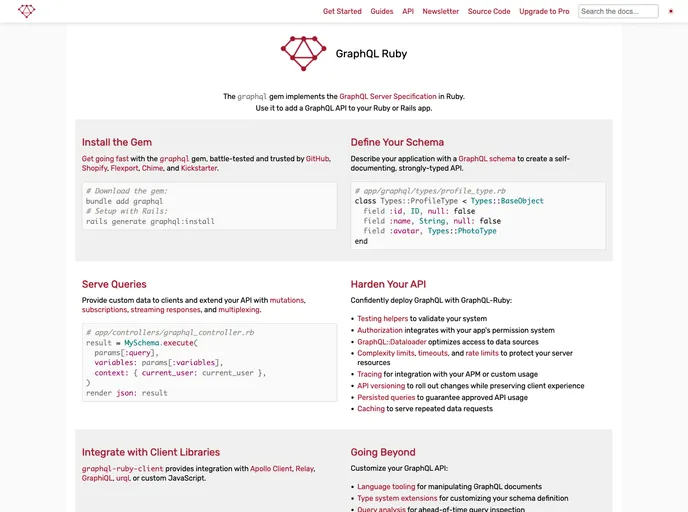

Ruby implementation of GraphQL
## Overview
GraphQL Ruby brings the power of GraphQL to the Ruby programming language, enabling developers to build efficient and expressive APIs. By utilizing GraphQL's flexible query language, developers can fetch exactly the data they need, optimizing network requests and improving the overall performance of their applications. This implementation is designed to seamlessly integrate with existing Ruby on Rails applications while providing the foundational elements needed to create a comprehensive API.

The community-driven nature of GraphQL Ruby fosters active contributions and continuous improvement, ensuring it stays up-to-date with GraphQL specifications. Whether you're building a new model or integrating into an existing one, GraphQL Ruby simplifies the process, making data fetching more intuitive and efficient for developers.

## Features
- **Flexible Querying**: Allows clients to specify exactly what data they need, reducing over-fetching and under-fetching issues common in REST APIs.
- **Type Safety**: Leverages Ruby's strong type system to ensure that queries and responses are validated against your schema, reducing runtime errors.
- **Eager Loading**: Supports ActiveRecord's eager loading capabilities to optimize database queries and improve performance.
- **Built-in Pagination**: Offers straightforward pagination methods, allowing developers to manage large datasets without performance degradation.
- **Support for Subscriptions**: Enables real-time updates by allowing clients to subscribe to specific data changes, enhancing user experience.
- **Integrates with Rails**: Seamlessly works with Ruby on Rails applications, allowing for easier API development without restructuring existing code.
- **Strong Community Support**: Active contributors and a wealth of documentation provide continual support and resources for developers starting with GraphQL in Ruby.
- Ruby on Rails
Ruby on Rails, often referred to as Rails, is an open-source web application framework written in Ruby. Known for its convention over configuration and don't repeat yourself (DRY) principles, Rails simplifies and accelerates the development of database-backed web applications.
- Graphql
A website that uses GraphQL as a query language to manage data fetching and state management. This includes features such as a strongly typed schema, client-side caching, and declarative data fetching to streamline data management and optimize website performance.