
Django Tasks
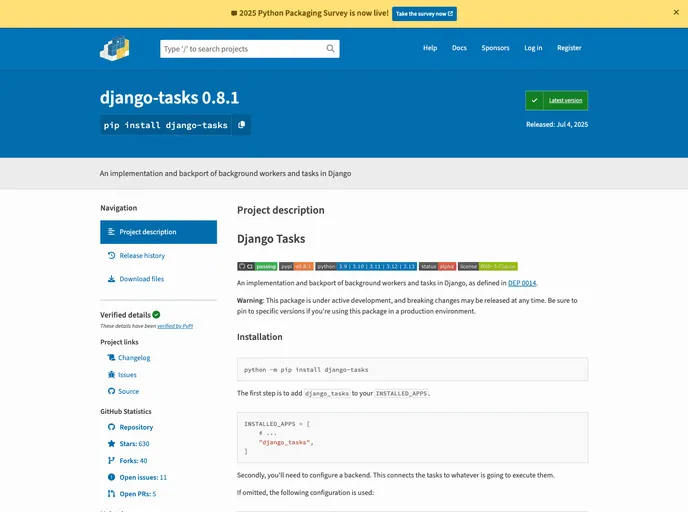

A reference implementation and backport of background workers and tasks in Django
Overview
Django Tasks offers an advanced solution for handling background workers and task scheduling within Django applications. This powerful library is still under active development, making it crucial for users to stay updated and manage versions carefully—especially in production environments. With an array of backend options and a friendly API for task creation and management, Django Tasks aims to streamline asynchronous processing tasks while maintaining flexibility and efficiency.
Whether you're looking to offload time-consuming processes or execute tasks based on certain conditions, Django Tasks provides a robust framework for managing these operations. The focus on ease-of-use and customization allows developers to integrate background processing seamlessly into their existing applications.
Features
- Multiple Backends: Choose from various task execution backends including Dummy, Immediate, Database, and RQ, enabling you to select the best fit for your use case.
- Task Decorator: Easily define tasks with a simple decorator that accepts parameters like
priority,queue_name, andbackend, allowing for organized and prioritized task management. - Run-Time Modification: Adjust task attributes at run-time using the
.usingmethod for additional flexibility during task execution. - Task Context: Access contextual information about tasks during execution by passing
takes_contextto the decorator, providing insight into the task's state and attempts. - Transaction Management: Tasks are enqueued after successful transaction commits by default, ensuring processes are reliably linked to your database states.
- Active Development: The library is continually being improved, promising future enhancements and extended API capabilities in response to developer needs.
- Django
Django is a high-level Python web framework that encourages rapid development and clean, pragmatic design. It follows the model-view-controller (MVC) architectural pattern, providing an extensive set of built-in tools and conventions to streamline the creation of robust and scalable web applications.