
Pickle UI
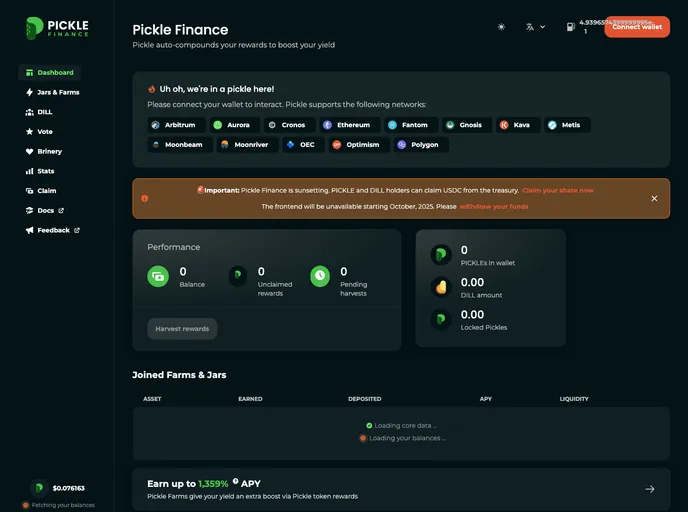





UI to interact with the PICKLE protocol
Overview
The Pickle App Frontend is an innovative tool designed to facilitate user interaction with the Pickle Protocol. Built from the ground up, this application leverages the capabilities of Next.js to create a seamless and responsive user experience. It allows users to navigate through the various features of the Pickle Protocol, making it an essential platform for DeFi enthusiasts.
By utilizing modern development practices, the Pickle App Frontend ensures optimal interaction with the protocol, streamlining processes while maintaining performance. Its emphasis on flexibility and design makes it an attractive option for users looking to engage with decentralized finance in a straightforward manner.
Features
-
Custom Built: Developed from scratch specifically for the Pickle Protocol, providing direct and efficient interaction.
-
Next.js Powered: Utilizes Next.js for enhanced performance and user experience through server-side rendering and optimized loading.
-
Image Handling: Supports square images in PNG format, ensuring a consistent visual appearance across the app.
-
Dynamic Resizing: Automatically resizes rendered images and delivers them in optimal formats (typically webp) for improved loading times.
-
Organized Asset Management: Tokens and protocols need to be placed in designated folders with specific naming conventions, simplifying asset management.
-
Color Integration: Requires addition of dominant colors to a centralized colors.ts file, promoting a unified visual theme for each protocol image.
-
Localization Support: Designed with localization in mind, allowing for seamless translation while maintaining essential format rules.
- Next.js
Next.js is a React-based web framework that enables server-side rendering, static site generation, and other powerful features for building modern web applications.
- React
React is a widely used JavaScript library for building user interfaces and single-page applications. It follows a component-based architecture and uses a virtual DOM to efficiently update and render UI components
- SCSS
SCSS is a preprocessor scripting language that extends the capabilities of CSS by adding features such as variables, nesting, and mixins. It allows developers to write more efficient and maintainable CSS code, and helps to streamline the development process by reducing repetition and increasing reusability.
- Tailwind
Tailwind CSS is a utility-first CSS framework that provides pre-defined classes for building responsive and customizable user interfaces.
- Geist UI
Geist UI is a modern, minimalist React component library inspired by Vercel's design language. It provides clean, elegant components with a focus on simplicity and developer experience, perfect for building modern web applications.
- Headless UI
Headless UI is a set of completely unstyled, fully accessible UI components for React, Vue, and Alpine.js that empower developers to build their own fully accessible custom UI components. Headless UI allows developers to focus on building accessible and highly functional user interfaces, without the need to worry about styling or layout.
- Eslint

ESLint is a linter for JavaScript that analyzes code to detect and report on potential problems and errors, as well as enforce consistent code style and best practices, helping developers to write cleaner, more maintainable code.
- Graphql
A website that uses GraphQL as a query language to manage data fetching and state management. This includes features such as a strongly typed schema, client-side caching, and declarative data fetching to streamline data management and optimize website performance.
- Postcss

PostCSS is a popular open-source tool that enables web developers to transform CSS styles with JavaScript plugins. It allows for efficient processing of CSS styles, from applying vendor prefixes to improving browser compatibility, ultimately resulting in cleaner, faster, and more maintainable code.
- React Hook Form

React Hook Form is a performant, flexible, and extensible form library for React with easy validation. It reduces re-renders and improves performance by using uncontrolled components and native HTML validation, making form handling simple and efficient.
- Recharts

Recharts is a powerful and easy-to-use React library for building customizable and interactive charts. Built on D3.js, it offers a wide range of pre-built chart types, such as line, bar, pie, and scatter charts, all of which can be composed with a declarative syntax.
- Typescript

TypeScript is a superset of JavaScript, providing optional static typing, classes, interfaces, and other features that help developers write more maintainable and scalable code. TypeScript's static typing system can catch errors at compile-time, making it easier to build and maintain large applications.