
Django Postgres Copy
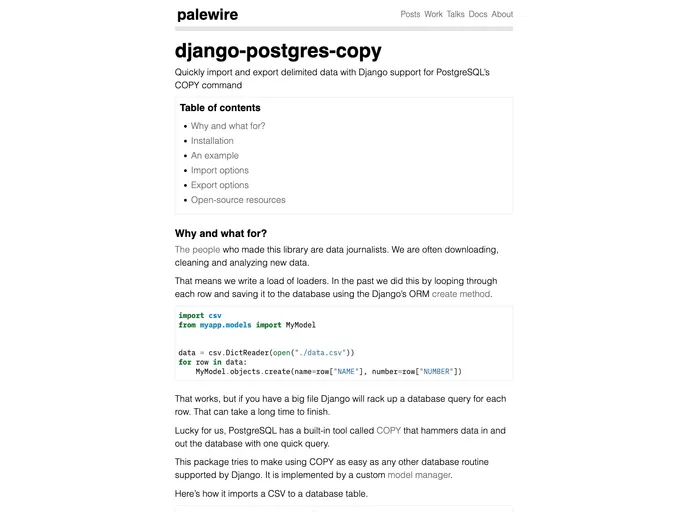

Quickly import and export delimited data with Django support for PostgreSQL's COPY command
## Overview
If you're working with Django and PostgreSQL, the `django-postgres-copy` package might just be the tool you need to streamline your data import and export processes. This package simplifies copying data between PostgreSQL tables and makes it easier to manage bulk operations. It's particularly useful for developers looking to improve the performance and usability of their database interactions.

This package provides a robust and efficient way to handle data transfers, making it an essential addition to any Django project that leverages PostgreSQL. With active development and a community behind it, there are plenty of resources to help you get started and troubleshoot any issues along the way.

## Features
- **Simplified Data Management**: Easily copy data between PostgreSQL tables without writing complex SQL manually, saving time and reducing errors.
- **Optimized Performance**: Designed for speed, it handles bulk operations efficiently, making database operations faster and more reliable.
- **Django Integration**: Seamlessly integrates with Django, allowing you to leverage its powerful ORM while working with database operations.
- **Active Community Support**: With a dedicated GitHub repository, users can report issues, contribute to development, and find solutions quickly.
- **Comprehensive Documentation**: Well-maintained documentation helps users navigate features and provides guidelines on setup and usage.
- **Testing Framework**: Built-in support for testing ensures that any changes made to the codebase are reliable and do not introduce bugs.
- **Flexible Development Environment**: Easily set up a local development environment to customize and explore the package further.
- Django
Django is a high-level Python web framework that encourages rapid development and clean, pragmatic design. It follows the model-view-controller (MVC) architectural pattern, providing an extensive set of built-in tools and conventions to streamline the creation of robust and scalable web applications.
- Fullstack

A fullstack boilerplate provides a starter application that includes both frontend and backend. It should include database, auth, payments, user roles and other backend services to build a fully featured saas or webapps.