
Customer Portal
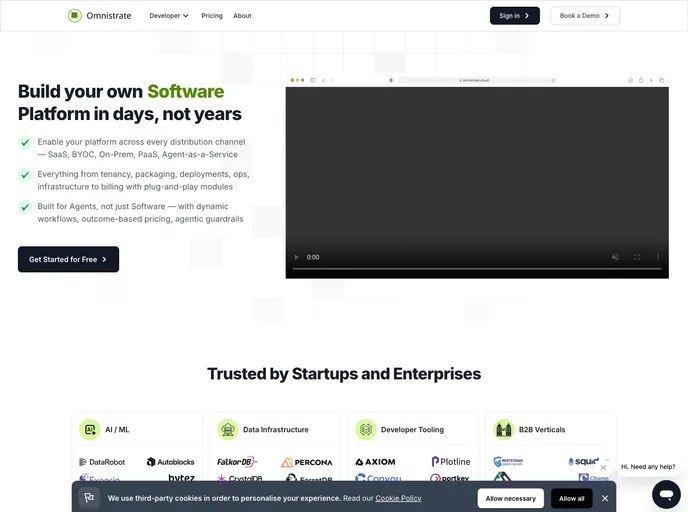




Working template for a SaaS service FrontEnd for Services created using Omnistrate
Overview
The Customer Portal project by Omnistrate offers a robust open-source platform aimed at service providers looking to deliver tailored SaaS solutions to their clients. Designed for flexibility, it allows for immediate deployment for those who need speed, while also offering extensive customization options for those who wish to dive deeper. This adaptability not only streamlines the development process for SaaS offerings but also fosters an environment of continuous innovation, drawing from the collective input and expertise of a global community of developers.
Getting started with the Customer Portal is relatively straightforward, ensuring that even those who may not be well-versed in frameworks like Next.js or Docker can successfully deploy the application with basic customizations. This balance between user-friendliness and customization capabilities makes it an attractive option for a variety of service providers.
Features
-
Open Source: The platform's open-source nature promotes community contributions, leading to ongoing improvements and innovations.
-
Easy Deployment: Rapid setup is feasible for service providers with minimal technical knowledge, streamlining time to market.
-
Customizable: Offers extensive customization options that allow developers to tailor the portal to their unique service requirements.
-
Seamless Integration: Designed to work in conjunction with the Omnistrate platform, simplifying the setup process for existing services.
-
Mandatory Customizations: Users are guided to input essential organizational information such as support emails and logos directly into their Omnistrate account for consistent branding.
-
Support Accessible: The configuration options include support details, enhancing the visibility and accessibility of customer support for end-users.
-
Service Plan Configurations: Encourages detailed customization of service plans, including pricing and support options, ensuring clarity for customers.
- Express
Express.js is a simple Node.js framework for single, multi-page, and hybrid web applications.
- Next.js
Next.js is a React-based web framework that enables server-side rendering, static site generation, and other powerful features for building modern web applications.
- React
React is a widely used JavaScript library for building user interfaces and single-page applications. It follows a component-based architecture and uses a virtual DOM to efficiently update and render UI components
- TanStack
TanStack is a collection of high-quality, framework-agnostic libraries including TanStack Query for data fetching, TanStack Router for routing, TanStack Table for tables, and more. These tools provide powerful, type-safe solutions for common web development challenges.
- SCSS
SCSS is a preprocessor scripting language that extends the capabilities of CSS by adding features such as variables, nesting, and mixins. It allows developers to write more efficient and maintainable CSS code, and helps to streamline the development process by reducing repetition and increasing reusability.
- Tailwind
Tailwind CSS is a utility-first CSS framework that provides pre-defined classes for building responsive and customizable user interfaces.
- Eslint

ESLint is a linter for JavaScript that analyzes code to detect and report on potential problems and errors, as well as enforce consistent code style and best practices, helping developers to write cleaner, more maintainable code.
- Formik

Formik is a popular form library for React that helps with form state management, validation, and submission handling. It provides a declarative approach to building forms with support for complex validation scenarios and easy integration with validation libraries like Yup.
- Postcss

PostCSS is a popular open-source tool that enables web developers to transform CSS styles with JavaScript plugins. It allows for efficient processing of CSS styles, from applying vendor prefixes to improving browser compatibility, ultimately resulting in cleaner, faster, and more maintainable code.
- Recharts

Recharts is a powerful and easy-to-use React library for building customizable and interactive charts. Built on D3.js, it offers a wide range of pre-built chart types, such as line, bar, pie, and scatter charts, all of which can be composed with a declarative syntax.
- Typescript

TypeScript is a superset of JavaScript, providing optional static typing, classes, interfaces, and other features that help developers write more maintainable and scalable code. TypeScript's static typing system can catch errors at compile-time, making it easier to build and maintain large applications.
- Yup
Yup is a schema builder for runtime value parsing and validation. It provides a declarative way to define validation schemas with support for complex nested objects, array validation, and custom validation rules. Often used with Formik for form validation.