
Swampy



Overview:
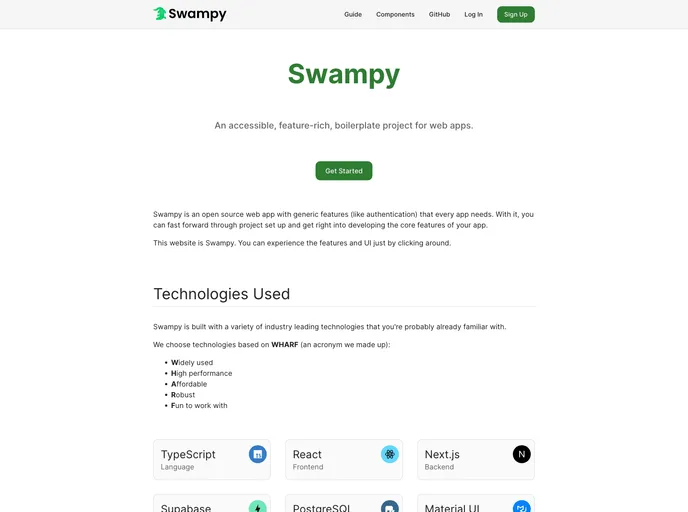
Swampy is an open-source web app boilerplate that provides generic features such as authentication that are necessary for every application. It aims to simplify the setup process so that developers can quickly start building the core features of their app. Swampy has an intuitive project structure that allows for easy customization while maintaining organization.
Features:
- Generic Features: Swampy includes generic features like authentication that are commonly required in web applications.
- Intuitive Project Structure: The project structure of Swampy is designed to make it easy to add and customize functionality while keeping everything organized.
- Environment Configuration: Swampy allows you to configure environment variables and code formatting rules.
- Public Resources: The public directory in Swampy is used for storing public resources, such as images.
- Database Scripts: Swampy includes pre-configured database scripts for setting up important triggers.
- Prisma Integration: Swampy provides files for managing Prisma's object-relational mapping for the PostgreSQL database.
- Page Components: Swampy provides a folder for creating components that render each page based on the given path.
- API Routing: The API folder in Swampy allows for creating API paths using Next JS routing.
- Common Components: Swampy includes a common folder for storing general components and utilities.
- Module Separation: Swampy's modules folder contains separate modules for different aspects of the application, such as authentication and messaging.
Summary:
Swampy is an open-source web app boilerplate that aims to simplify the setup process for developers. It provides generic features like authentication and an intuitive project structure that allows for easy customization while maintaining organization. With Swampy, developers can quickly start developing the core features of their application without spending time on repetitive setup tasks.
- Next.js
Next.js is a React-based web framework that enables server-side rendering, static site generation, and other powerful features for building modern web applications.
- React
React is a widely used JavaScript library for building user interfaces and single-page applications. It follows a component-based architecture and uses a virtual DOM to efficiently update and render UI components
- Prisma
Prisma is a server-side library that helps developers read and write data to the database in an intuitive, efficient and safe way.
- Fullstack

A fullstack boilerplate provides a starter application that includes both frontend and backend. It should include database, auth, payments, user roles and other backend services to build a fully featured saas or webapps.
- Eslint

ESLint is a linter for JavaScript that analyzes code to detect and report on potential problems and errors, as well as enforce consistent code style and best practices, helping developers to write cleaner, more maintainable code.
- Typescript

TypeScript is a superset of JavaScript, providing optional static typing, classes, interfaces, and other features that help developers write more maintainable and scalable code. TypeScript's static typing system can catch errors at compile-time, making it easier to build and maintain large applications.
- Zustand
Zustand is a lightweight state management library for React that provides a simple and intuitive API for managing state in your application. It allows developers to easily create and manage global state, and provides a powerful set of tools for optimizing performance and improving developer productivity. Zustand is designed to be easy to use and easy to learn, making it a popular choice for developers of all skill levels.