
Material UI Number Input
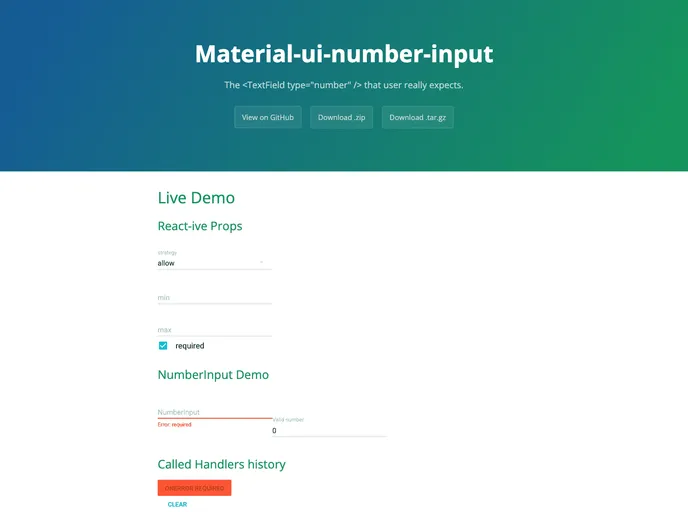



The <TextField type="number" /> that user really expects.
Overview
The material-ui-number-input project offered a streamlined solution for handling number inputs within user interfaces built with Material-UI. Unfortunately, it is no longer maintained and has been labeled as deprecated. Despite its current status, it’s worth exploring the features it provided when it was actively supported, especially for those who might be working with legacy systems that still incorporate this component.
The number input component was designed to enhance the user experience by providing various customizable options while adhering to the Material Design guidelines. Even though it might not be the best choice for new projects, understanding its capabilities could be helpful for developers dealing with older implementations.
Features
-
Children: Supports rendering of additional nodes inside the input field, providing flexibility for customization.
-
ClassName: Allows customization of the component’s styling through a CSS class name, enhancing visual control.
-
Disabled: Offers a functionality that disables the input field when true, ensuring users cannot interact with it.
-
FloatingLabelFixed: Maintains the floating label position even when the input is empty, improving UX consistency.
-
FullWidth: When enabled, this feature allows the input component to stretch to the full width of its container, optimizing layout and usability.
-
DefaultValue: Lets developers set a default numeric value for the input, ensuring it falls within defined min and max limits when applicable.
-
OnChange: Provides a callback function that triggers whenever the input value changes, facilitating dynamic interactions and data handling.
-
OnError: Responsible for handling error statuses, alerting developers when input validation issues arise, adding a layer of reliability to user inputs.
- Express
Express.js is a simple Node.js framework for single, multi-page, and hybrid web applications.
- React
React is a widely used JavaScript library for building user interfaces and single-page applications. It follows a component-based architecture and uses a virtual DOM to efficiently update and render UI components
- Material UI
material-ui adds classes to Tailwind CSS for all common UI components. Classes like btn, card, etc. This allows us to focus on important things instead of making basic elements for every project.
- Material Design

Material Design is a design system developed by Google that provides a set of guidelines, components, and tools for creating visually appealing and functional user interfaces. Material Design is designed to be flexible and customizable, making it a great choice for a wide range of applications and use cases.
- Typescript

TypeScript is a superset of JavaScript, providing optional static typing, classes, interfaces, and other features that help developers write more maintainable and scalable code. TypeScript's static typing system can catch errors at compile-time, making it easier to build and maintain large applications.
- Webpack

Webpack is a popular open-source module bundler for JavaScript applications that bundles and optimizes the code and its dependencies for production-ready deployment. It can also be used to transform other types of assets such as CSS, images, and fonts.