
Ng Portal
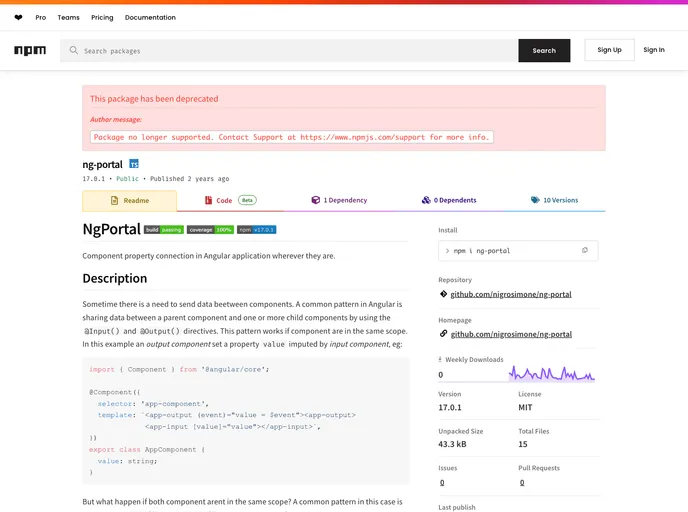

Component property connection in Angular application wherever they are.
Overview
NgPortal is an innovative Angular directive designed to simplify data sharing between components, regardless of their hierarchical position within the application. Often, developers face challenges when trying to communicate between parent and child components, especially when they're not directly connected. With NgPortal, data can be effortlessly shared across a component tree, enabling smoother interactions and real-time updates.
This directive introduces a new level of flexibility and efficiency to Angular applications, allowing developers to utilize two-way data binding, mono-directional communication, and support for asynchronous operations, all while minimizing the complexity of data management within the app.
Features
-
Two-Way Data Binding: Seamlessly synchronize property changes between components using the @NgPortal() directive, promoting efficient data management.
-
Mono-Directional Communication: Utilize @NgPortalInput() and @NgPortalOutput() directives to control data flow direction — send or receive changes as needed.
-
Async Pipe Support: Enhance your application with built-in support for asynchronous data handling, allowing for dynamic updates without manual intervention.
-
NgModel Support: Integrate with Angular's NgModel for better form control and model management, making it easier to work with reactive forms.
-
Custom Decorator Options: Utilize diverse options with the property decorators to customize the communication between components, enhancing versatility in interactions.
-
Getter and Setter Automation: Automatically apply getters and setters to properties, streamlining code and reducing boilerplate, while ensuring smooth data exchange.
This comprehensive approach to data communication not only boosts the performance of Angular applications but also simplifies the overall development process. Start utilizing NgPortal today for a more connected and responsive application architecture!
- Angular
Angular is a TypeScript-based open-source framework by Google for building dynamic single-page applications and cross-platform mobile apps with MVC architecture and a rich set of features.
- Eslint

ESLint is a linter for JavaScript that analyzes code to detect and report on potential problems and errors, as well as enforce consistent code style and best practices, helping developers to write cleaner, more maintainable code.
- Typescript

TypeScript is a superset of JavaScript, providing optional static typing, classes, interfaces, and other features that help developers write more maintainable and scalable code. TypeScript's static typing system can catch errors at compile-time, making it easier to build and maintain large applications.