
Next Platform Starter
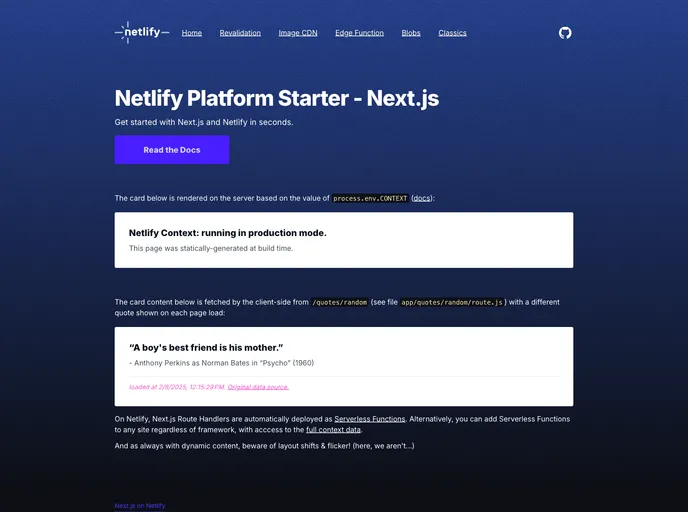


Modern starter based on Next.js 16 (App Router), Tailwind, and Netlify core primitives
Overview
The Next.js on Netlify Platform Starter is an impressive modern starter kit designed for developers looking to leverage the power of Next.js 16 with the seamless hosting capabilities of Netlify. This template is built on a robust combination of Next.js, Tailwind CSS, and essential Netlify Core Primitives such as Edge Functions and Image CDN. Ideal for both seasoned developers and newcomers, it provides an established foundation for creating optimized web applications effortlessly.
What sets this starter apart is its dual approach to utilizing Netlify's features: both implicitly through Next.js functionalities and explicitly through user code. This ensures a streamlined deployment experience where developers can focus on building their applications without worrying about the underlying infrastructure.
Features
- Seamless Integration with Next.js: Utilizes Next.js 16's App Router, enabling straightforward routing and enhanced performance features effortlessly.
- Tailored for Developer Experience: Built-in support for Tailwind CSS allows for rapid UI development with a modern, utility-first approach.
- Optimized Image Handling: Leveraging Netlify's Image CDN, it provides automatic image optimization through Next.js's next/image component, ensuring quick load times.
- Edge Functions Support: Built to utilize Netlify Edge Functions, this starter allows for reduced latency and improved performance by executing code closer to users.
- Full Development Functionality: By using the latest version of Netlify CLI, developers can run a fully functional local environment that mimics the deployed version.
- Framework-Agnostic Flexibility: Explicit usage of Netlify Core Primitives enhances the starter's capabilities beyond typical Next.js features, offering advanced options for developers.
- Effortless Deployment: With just a click, you can deploy to your Netlify account, simplifying the deployment process and saving time.
- Local Development Support: Comprehensive setup instructions ensure that the transition from local development to deployment is smooth and efficient.
- Next.js
Next.js is a React-based web framework that enables server-side rendering, static site generation, and other powerful features for building modern web applications.
- React
React is a widely used JavaScript library for building user interfaces and single-page applications. It follows a component-based architecture and uses a virtual DOM to efficiently update and render UI components
- Tailwind
Tailwind CSS is a utility-first CSS framework that provides pre-defined classes for building responsive and customizable user interfaces.
- Templates & Themes

A template or theme refers to a pre-designed layout or structure that provides a basic framework for building a specific type of application or website. It typically includes good design, placeholder content and functional features, allowing developers to customize and fill in the details according to their specific needs.
- Eslint

ESLint is a linter for JavaScript that analyzes code to detect and report on potential problems and errors, as well as enforce consistent code style and best practices, helping developers to write cleaner, more maintainable code.
- Postcss

PostCSS is a popular open-source tool that enables web developers to transform CSS styles with JavaScript plugins. It allows for efficient processing of CSS styles, from applying vendor prefixes to improving browser compatibility, ultimately resulting in cleaner, faster, and more maintainable code.