
Nestjs Mod Fullstack
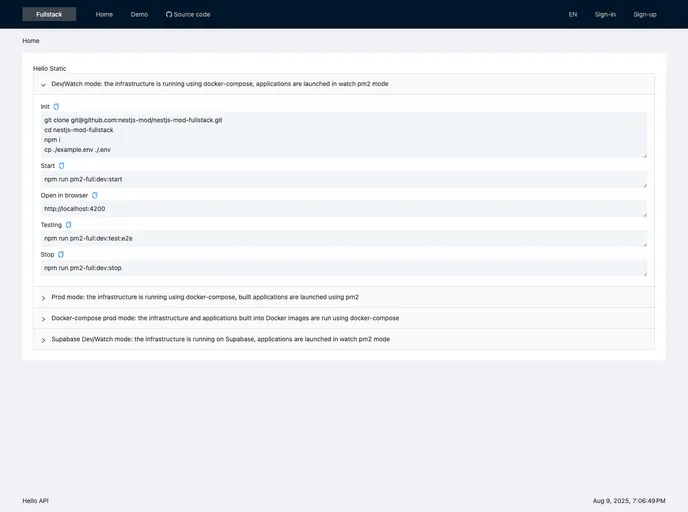





Boilerplate for creating a fullstack application on NestJS and Angular
Overview
The NestJS Modular framework offers a robust and streamlined approach to developing applications through its comprehensive structure. Aimed at developers seeking to unify their applications and modules, it provides a solid foundation with flexible infrastructure options. With support for deployments on Kubernetes, Vercel, and Supabase, this framework is particularly appealing for its capability to adapt to varying development needs, ensuring consistency and ease of use across projects.
The framework simplifies the process of running applications through the use of Docker containers, making it easier to manage various environments. Whether you're looking to test your application in watch mode or deploy it in a production-ready setting, NestJS Modular supports a variety of configurations to accommodate your specific requirements.
Features
-
Flexible Deployment Options: Easily deploy on Kubernetes, Vercel, or Supabase for a wide range of infrastructure needs.
-
Docker-Compose Integration: Set up and manage your application environment seamlessly with Docker, whether in development, testing, or production modes.
-
Watch Mode Support: Develop and test applications in real-time with the watch pm2 mode, allowing for quick iterations during the development process.
-
Supabase Compatibility: Create projects and manage storage effortlessly with Supabase’s integration, enhancing your application's backend capabilities.
-
Environment Configuration: Simple setup through a .env file to manage keys and connection strings, ensuring your environment is easy to configure and maintain.
-
Centralized Management: Utilize shared utilities for unifying your modules and applications, streamlining the development process across various projects.
-
Community Support: Access a dedicated Telegram group for questions and assistance, fostering collaboration and support among developers using the framework.
- Angular
Angular is a TypeScript-based open-source framework by Google for building dynamic single-page applications and cross-platform mobile apps with MVC architecture and a rich set of features.
- Express
Express.js is a simple Node.js framework for single, multi-page, and hybrid web applications.
- Nest
A progressive Node.js framework for building efficient, scalable, and enterprise-grade server-side applications with TypeScript/JavaScript.
- Tailwind
Tailwind CSS is a utility-first CSS framework that provides pre-defined classes for building responsive and customizable user interfaces.
- Prisma
Prisma is a server-side library that helps developers read and write data to the database in an intuitive, efficient and safe way.
- Fullstack

A fullstack boilerplate provides a starter application that includes both frontend and backend. It should include database, auth, payments, user roles and other backend services to build a fully featured saas or webapps.
- Docker

A website that uses Docker for containerization to streamline development, testing, and deployment workflows. This includes features such as containerization of dependencies, automated builds and deployments, and container orchestration to ensure scalability and availability.
- Eslint

ESLint is a linter for JavaScript that analyzes code to detect and report on potential problems and errors, as well as enforce consistent code style and best practices, helping developers to write cleaner, more maintainable code.
- Postcss

PostCSS is a popular open-source tool that enables web developers to transform CSS styles with JavaScript plugins. It allows for efficient processing of CSS styles, from applying vendor prefixes to improving browser compatibility, ultimately resulting in cleaner, faster, and more maintainable code.
- Typescript

TypeScript is a superset of JavaScript, providing optional static typing, classes, interfaces, and other features that help developers write more maintainable and scalable code. TypeScript's static typing system can catch errors at compile-time, making it easier to build and maintain large applications.