
Glassmorphism Admin Panel UI
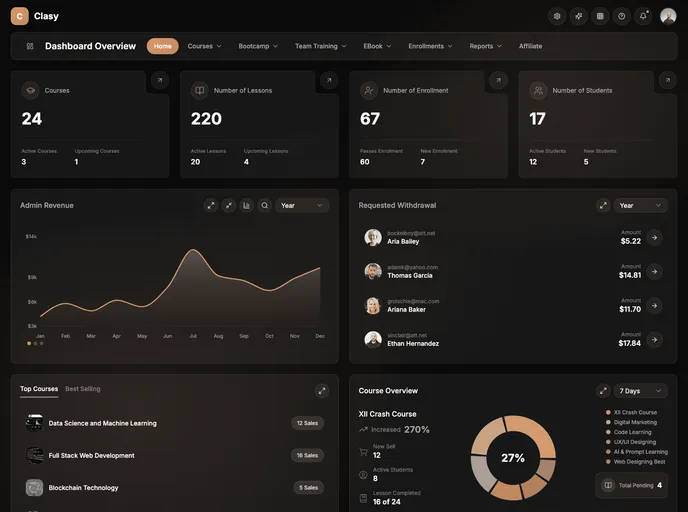


Sleek admin panel featuring real-time adjustable glassmorphism UI. Control blur, opacity, and saturation from settings. Next.js 15 + Tailwind CSS + Radix UI.
Overview
The Glassmorphism Admin Panel UI presents a modern and visually captivating dashboard optimized for efficient management of educational programs, bootcamps, and e-books. Crafted with Next.js 16 and React 19, it embraces the trending glassmorphism design, offering a sleek, contemporary aesthetic that enhances user engagement. This fully-featured platform integrates various essential functionalities, making it an ideal solution for course management, user tracking, and revenue analytics.
In addition to its stunning visuals, the admin panel is equipped with comprehensive tools that facilitate an organized and user-friendly experience. From customizable theme options to detailed reporting features, the dashboard equips administrators with everything needed to efficiently oversee operations while ensuring an appealing interface.
Features
-
Dashboard Statistics: Get a quick overview of courses, lessons, enrollments, and student metrics, along with revenue analytics displayed through interactive charts.
-
Comprehensive Course Management: Perform full CRUD operations on courses, including search and filter options to easily access course details based on various criteria like status and rating.
-
User Management: Multi-role support allowing administrators to efficiently handle roles (Admin, Instructor, Student) while tracking user statistics and activities.
-
Bootcamp Administration: Manage bootcamp listings, including tracking participant status, duration, pricing, and more, ensuring better control over training programs.
-
E-book Catalog Management: Organize e-books, track sales and ratings, and categorize them for easy navigation, further enhancing user experience.
-
Advanced Reporting & Analytics: Generate monthly revenue reports and visualize user activities and revenue trends with robust export functionality.
-
Customizable Themes: Choose from 8 built-in color palettes and customize glass effect settings to suit your branding, including background opacity and blur options.
-
Interactive UI Components: Benefit from a rich library of UI components and animations, providing a smooth and aesthetically appealing user interaction.
- Next.js
Next.js is a React-based web framework that enables server-side rendering, static site generation, and other powerful features for building modern web applications.
- React
React is a widely used JavaScript library for building user interfaces and single-page applications. It follows a component-based architecture and uses a virtual DOM to efficiently update and render UI components
- Tailwind
Tailwind CSS is a utility-first CSS framework that provides pre-defined classes for building responsive and customizable user interfaces.
- Eslint

ESLint is a linter for JavaScript that analyzes code to detect and report on potential problems and errors, as well as enforce consistent code style and best practices, helping developers to write cleaner, more maintainable code.
- Framer Motion

Alpine.js is a lightweight JavaScript framework that simplifies the process of creating dynamic, reactive user interfaces on the web. It uses a declarative syntax that offers a higher level of abstraction compared to vanilla JavaScript, while being more performant and easier to use than jQuery.
- Postcss

PostCSS is a popular open-source tool that enables web developers to transform CSS styles with JavaScript plugins. It allows for efficient processing of CSS styles, from applying vendor prefixes to improving browser compatibility, ultimately resulting in cleaner, faster, and more maintainable code.
- Recharts

Recharts is a powerful and easy-to-use React library for building customizable and interactive charts. Built on D3.js, it offers a wide range of pre-built chart types, such as line, bar, pie, and scatter charts, all of which can be composed with a declarative syntax.
- Typescript

TypeScript is a superset of JavaScript, providing optional static typing, classes, interfaces, and other features that help developers write more maintainable and scalable code. TypeScript's static typing system can catch errors at compile-time, making it easier to build and maintain large applications.