
UI
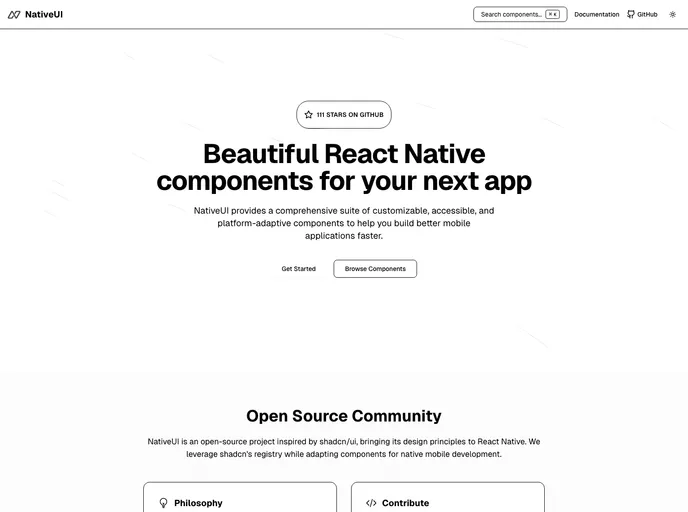



A set of beautifully-designed, accessible React Native components distributed via the shadcn registry. Works with Expo and your favorite tools. Open Source.
Overview
NativeUI is an impressive suite of beautifully designed React Native components that can be effortlessly integrated into your mobile applications. This open-source resource emphasizes accessibility and customization, empowering developers to take control over their code and design. With a focus on simplicity, you can copy and paste the provided components directly into your project without the need for additional package installations.
What truly sets NativeUI apart is its mobile-first approach, optimized for both iOS and Android platforms. Developers can expect to find components that not only look great but are also constructed with considerations for users relying on keyboard navigation and screen readers. Ready to explore the capabilities of NativeUI? Here’s what you might find exciting about it.
Features
- No Installation Required: Simply copy and paste the components into your project; there’s no need for npm package installations.
- Customizable Design: Built with Tailwind CSS, you can easily tweak the components to fit the unique styling of your app.
- Accessibility Focus: Designed with users in mind, ensuring compatibility with screen readers and keyboard navigation for an inclusive experience.
- Mobile-First Optimization: Components are tailored to work seamlessly on both iOS and Android, enhancing the performance of your mobile applications.
- Open Source Freedom: Enjoy the ease of using these components under the MIT license, giving you ownership and control over your code.
- Reference for Custom Libraries: Use NativeUI as a foundation to build your own component libraries, enhancing your development process.
- Sensible Defaults: Start with a strong base that allows you to customize components according to your specific requirements.
- Next.js
Next.js is a React-based web framework that enables server-side rendering, static site generation, and other powerful features for building modern web applications.
- React
React is a widely used JavaScript library for building user interfaces and single-page applications. It follows a component-based architecture and uses a virtual DOM to efficiently update and render UI components
- React Native
React Native is a framework for building mobile applications using React and JavaScript. It enables developers to write once and deploy to multiple platforms, including iOS, Android, and the web, while providing a native app-like experience to users.
- Tailwind
Tailwind CSS is a utility-first CSS framework that provides pre-defined classes for building responsive and customizable user interfaces.
- cmdk
cmdk is a fast, composable command menu component for React. It provides the foundation for building command palettes, search interfaces, and keyboard-navigable menus similar to those found in applications like VS Code, Linear, and Raycast.
- Shadcn UI
Beautifully designed components that you can copy and paste into your apps. Accessible. Customizable. Open Source.
- Eslint

ESLint is a linter for JavaScript that analyzes code to detect and report on potential problems and errors, as well as enforce consistent code style and best practices, helping developers to write cleaner, more maintainable code.
- Expo
An open-source platform for making universal native apps with React. Expo runs on Android, iOS, and the web.
- Framer Motion

Alpine.js is a lightweight JavaScript framework that simplifies the process of creating dynamic, reactive user interfaces on the web. It uses a declarative syntax that offers a higher level of abstraction compared to vanilla JavaScript, while being more performant and easier to use than jQuery.
- MDX

MDX is a format that allows developers to write JSX within Markdown documents, combining the power of React with the simplicity of Markdown. This allows for the creation of dynamic and interactive content that can be easily shared and consumed across different platforms and devices.
- Typescript

TypeScript is a superset of JavaScript, providing optional static typing, classes, interfaces, and other features that help developers write more maintainable and scalable code. TypeScript's static typing system can catch errors at compile-time, making it easier to build and maintain large applications.