
Django Mongodb Backend
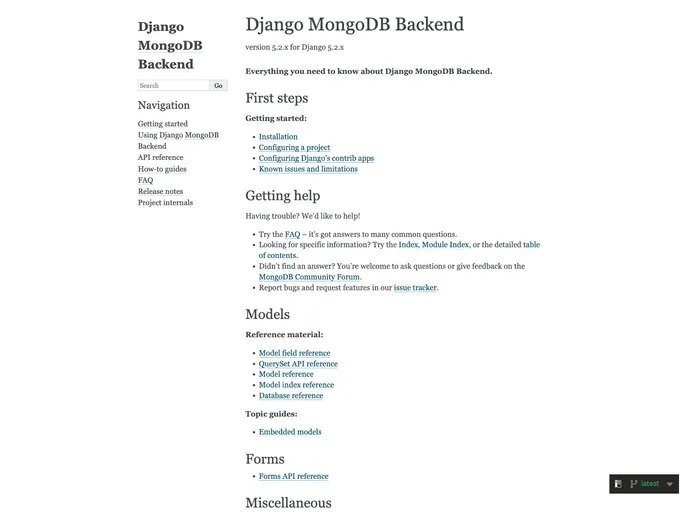

Django MongoDB Backend
Overview
The Django MongoDB Backend offers a novel integration of Django with MongoDB, allowing developers to harness the power of a NoSQL database while utilizing Django's full feature set. Although it's currently a work in progress and not yet recommended for production environments, its potential is notable. As a backend still under development, users can look forward to improvements and new features based on community feedback and contributions.
This backend enables developers to model their data exactly as they need using Django's ORM, providing a bridge between traditional Django features and the flexibility of MongoDB. It's geared towards those who wish to explore modern database alternatives while maintaining the Django framework’s familiar interface.
Features
-
Model MongoDB Documents: Store Django model instances as MongoDB documents, seamlessly integrating NoSQL data modeling with Django's structure.
-
Custom Fields: Offers custom fields such as ArrayField for handling arrays and EmbeddedModelField for embedded documents, enhancing data representation capabilities.
-
Index Management: Create single, compound, partial, and unique indexes using Django Indexes, allowing for optimized database performance.
-
Querying Data: Supports the majority of the Django QuerySet API, enabling developers to perform complex queries with familiar syntax while also making use of MongoDB's powerful querying capabilities.
-
Administrator Dashboard: Manage data effectively through Django's built-in admin site, with full integration into Django’s authentication framework for seamless user management.
-
Community Support: Engage with a robust community through the MongoDB Community Forums for assistance with general questions, enhancing collaborative learning and troubleshooting.
-
Issue Tracking: Report bugs or suggest features conveniently via JIRA, ensuring user feedback directly contributes to ongoing development and enhancement of the backend.
- Django
Django is a high-level Python web framework that encourages rapid development and clean, pragmatic design. It follows the model-view-controller (MVC) architectural pattern, providing an extensive set of built-in tools and conventions to streamline the creation of robust and scalable web applications.