
Prisma Next Typescript



Overview
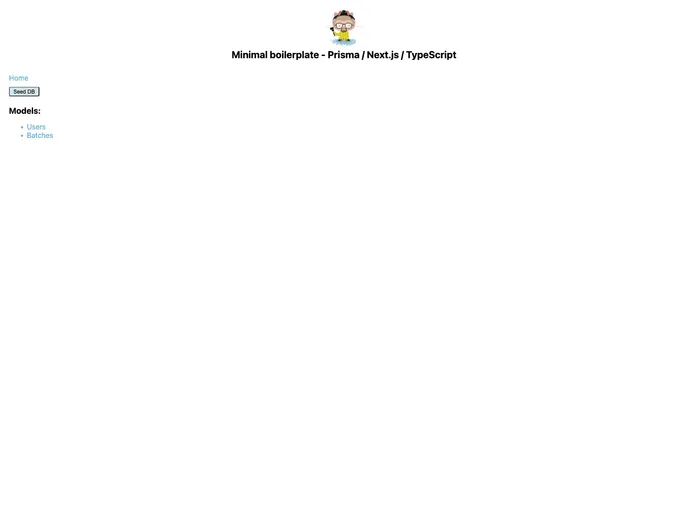
The Heisenberg boilerplate is a powerful starting point for developers looking to build applications using Prisma, Next.js, and TypeScript. With a focus on best practices and an excellent developer experience, this boilerplate streamlines the setup process while ensuring best-in-class coding standards. Ideal for those who want to hit the ground running without excessive overhead, it emphasizes minimalism and the integration of essential features for creating robust applications.
Developers can leverage the Heisenberg boilerplate to easily create a local development environment, and benefit from features designed to enhance productivity, such as seamless API integration and thorough type-safety across the entire stack. This boilerplate is an excellent choice for those familiar with modern JavaScript technologies and looking to implement a solid foundational structure in their projects.
Features
- Minimal Setup: Quickly get started with a streamlined configuration that can be extended as needed, without unnecessary UI complexities or utility libraries.
- Local Development Environment: Spin up a local environment effortlessly using Docker, complete with a seeded Postgres database by running simple npm commands.
- TypeScript Integration: Enjoy end-to-end type safety with TypeScript, ensuring consistent data handling from the database all the way to the frontend.
- RESTful API: Built-in support for creating RESTful APIs using Next.js, making it easy to manage backend operations without hassle.
- Testing Capabilities: Incorporate unit and integration tests seamlessly with Jest, ensuring your code remains robust and reliable.
- Linting and Formatting: Benefit from automated linting using ESLint and code formatting with Prettier to maintain code quality effortlessly.
- Git Hooks Support: Utilize Husky and lint-staged for Git hooks that help maintain commit message standards and improve overall workflow efficiency.
- Contribution Welcomed: An open attitude towards contributions encourages collaboration and continuous improvement of the boilerplate.
- Next.js
Next.js is a React-based web framework that enables server-side rendering, static site generation, and other powerful features for building modern web applications.
- React
React is a widely used JavaScript library for building user interfaces and single-page applications. It follows a component-based architecture and uses a virtual DOM to efficiently update and render UI components
- Prisma
Prisma is a server-side library that helps developers read and write data to the database in an intuitive, efficient and safe way.
- Fullstack

A fullstack boilerplate provides a starter application that includes both frontend and backend. It should include database, auth, payments, user roles and other backend services to build a fully featured saas or webapps.
- Eslint

ESLint is a linter for JavaScript that analyzes code to detect and report on potential problems and errors, as well as enforce consistent code style and best practices, helping developers to write cleaner, more maintainable code.
- Typescript

TypeScript is a superset of JavaScript, providing optional static typing, classes, interfaces, and other features that help developers write more maintainable and scalable code. TypeScript's static typing system can catch errors at compile-time, making it easier to build and maintain large applications.