
Microsoft Graph Toolkit
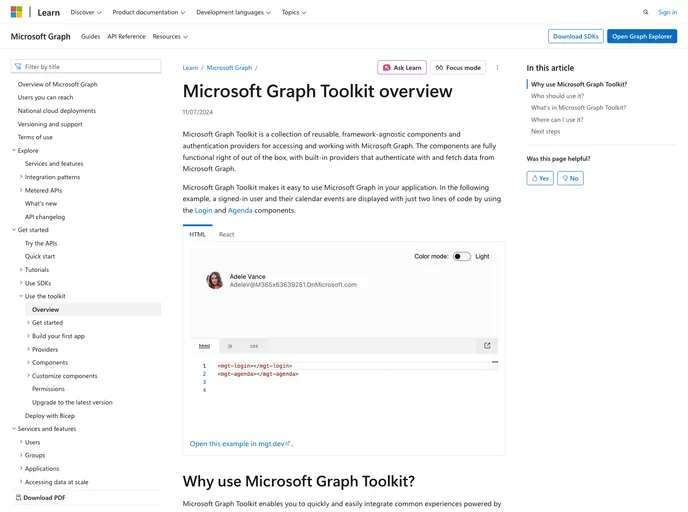


Authentication Providers and UI components for Microsoft Graph
Overview
The Microsoft Graph Toolkit offers a powerful suite of authentication providers and UI components designed to simplify interactions with Microsoft Graph. With its user-friendly framework, developers can easily integrate Microsoft Graph functionalities into their applications, enhancing user experience while leveraging the vast capabilities of Microsoft's ecosystem.
Whether you're building a personal project or a professional application, the toolkit streamlines the authentication process and provides ready-to-use UI components that reduce development time. This makes it an excellent choice for those looking to enhance their applications with Microsoft Graph's robust features without the steep learning curve typically associated with such integrations.
Features
-
Seamless Authentication: Integrates multiple authentication providers, allowing users to sign in quickly using their Microsoft accounts or other identity providers.
-
Pre-built UI Components: Offers a variety of ready-to-use UI components, such as sign-in buttons and user profile cards, to expedite the development process.
-
Customization Options: Provides flexibility to customize UI components, enabling developers to maintain brand consistency while using Microsoft's standards.
-
Real-time Data Access: Facilitates real-time access to Microsoft Graph data, providing users with up-to-date information without complex queries.
-
Cross-platform Compatibility: Works seamlessly across various platforms, ensuring that applications can reach a broad audience regardless of device or operating system.
-
Documentation and Support: Includes comprehensive documentation and resources, helping developers get started quickly and fostering a supportive community for troubleshooting.
- React
React is a widely used JavaScript library for building user interfaces and single-page applications. It follows a component-based architecture and uses a virtual DOM to efficiently update and render UI components
- SCSS
SCSS is a preprocessor scripting language that extends the capabilities of CSS by adding features such as variables, nesting, and mixins. It allows developers to write more efficient and maintainable CSS code, and helps to streamline the development process by reducing repetition and increasing reusability.
- Eslint

ESLint is a linter for JavaScript that analyzes code to detect and report on potential problems and errors, as well as enforce consistent code style and best practices, helping developers to write cleaner, more maintainable code.
- Rollup

RollupJS is a popular and efficient JavaScript module bundler that takes the code from multiple modules and packages them into a single optimized file, minimizing the overall size of the application and improving its performance.
- Storybook
Storybook is a tool for developing and testing UI components in isolation. It provides a sandbox environment where you can experiment with different props and states to see how your component responds.
- Stylelint
Stylelint is a modern linter for CSS that helps you avoid errors and enforce consistent styling conventions. It provides rules for detecting errors and warnings, and can be configured to match your specific project's requirements.
- Typescript

TypeScript is a superset of JavaScript, providing optional static typing, classes, interfaces, and other features that help developers write more maintainable and scalable code. TypeScript's static typing system can catch errors at compile-time, making it easier to build and maintain large applications.
- Web Components

Web components provide a way to create reusable, encapsulated UI components using standard web technologies such as HTML, CSS, and JavaScript. They allow developers to create complex UI components that can be easily shared across multiple projects and frameworks. Web components are built using four main specifications: Custom Elements, Shadow DOM, HTML Templates, and ES Modules.
- Webpack

Webpack is a popular open-source module bundler for JavaScript applications that bundles and optimizes the code and its dependencies for production-ready deployment. It can also be used to transform other types of assets such as CSS, images, and fonts.