
Angularjs In Patterns
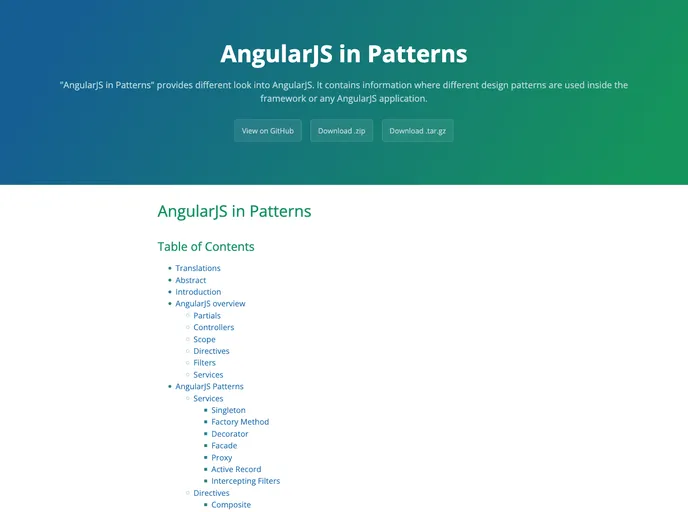

AngularJS in patterns - this repository provides different look into AngularJS. It contains information where different design patterns are used inside the framework or any Angular application.
Overview
AngularJS is a prominent JavaScript framework developed by Google, designed specifically for creating single-page applications (SPAs) that operate with seamless transitions and dynamic content updates. By employing a model-view-controller (MVC) architecture, AngularJS simplifies the development process through features such as two-way data binding, dependency injection, and a clear separation of concerns. This framework allows developers to build rich applications that offer a smooth user experience without traditional page reloads.
In this document, a variety of design and architectural patterns utilized within AngularJS applications are explored. By grouping these patterns with their respective components—like controllers, services, and directives—developers can gain a deeper understanding of how to effectively leverage AngularJS in their projects for better structure and efficiency.
Features
-
Two-way Data Binding: Automatically synchronizes data between the model and the view, reducing the need for manual updates and enhancing user experience.
-
Dependency Injection: Built-in support for managing dependencies, which allows for more modular and testable code, making applications easier to maintain.
-
Separation of Concerns: Clearly divides application logic into distinct components (partials, controllers, services) to improve maintainability and scalability.
-
Modular Architecture: Utilizes modules to organize components effectively, promoting a high level of abstraction that facilitates development in larger applications.
-
Testability: The design of AngularJS allows for easy testing of components, which is essential for ensuring reliability and performance.
-
Abstraction: Simplifies complex functionality by encapsulating features within components, improving code clarity and reusability in development.
-
Rich Ecosystem: A vibrant community and a wide array of third-party resources and plugins that enhance the capabilities of AngularJS, allowing developers to implement additional features with ease.
-
Active Record Pattern: A design pattern used in managing data, allowing models to be responsible for their own persistence without tightly coupling the data logic to the business logic.
- Angular
Angular is a TypeScript-based open-source framework by Google for building dynamic single-page applications and cross-platform mobile apps with MVC architecture and a rich set of features.
- Gulp

Gulp.js is an old but popular site building tool that automates various repetitive development tasks in web development, such as compiling Sass, minifying JavaScript, and optimizing images.