
News UI
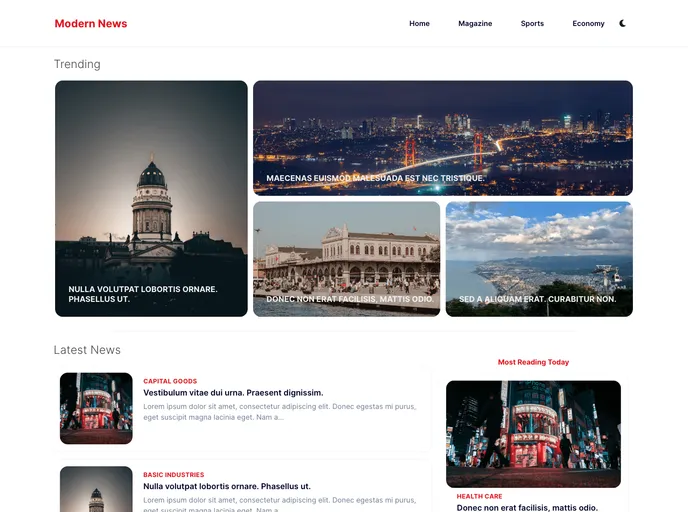


News web app with Next.js, TypeScript and Chakra UI.
Overview
News UI is a desktop news web app built using Next.js, TypeScript, and Chakra UI. It provides users with a sleek and intuitive interface to browse and read the latest news articles. By leveraging the power of Next.js and TypeScript, this web app delivers a seamless user experience while ensuring type safety and code efficiency. The integration of Chakra UI adds a touch of modern design and responsiveness to the overall look and feel of the application.
Features
- Sleek and intuitive interface: The News UI web app offers a user-friendly interface that is easy to navigate and browse through the latest news articles.
- Next.js and TypeScript: Developed with Next.js and TypeScript, the app benefits from Next.js's server-side rendering capabilities, resulting in fast page load times and improved SEO. TypeScript ensures type safety and helps catch errors early in the development process.
- Chakra UI integration: The integration of Chakra UI allows for easy customization and theming of the web app. It provides a modern and responsive design out of the box.
Summary
News UI is a powerful desktop news web app built with Next.js, TypeScript, and Chakra UI. It offers a sleek and intuitive interface for users to browse and read the latest news articles. The integration of Next.js and TypeScript ensures high performance and type safety, while Chakra UI adds modern design and responsiveness to the application. The installation process is straightforward, making it easy for developers to get started with building their own news web apps using News UI as a foundation.
- Next.js
Next.js is a React-based web framework that enables server-side rendering, static site generation, and other powerful features for building modern web applications.
- React
React is a widely used JavaScript library for building user interfaces and single-page applications. It follows a component-based architecture and uses a virtual DOM to efficiently update and render UI components
- Chakra UI
Chakra UI is a popular open-source React component library that provides a set of accessible and customizable UI components to help developers create modern web applications.
- Framer Motion

Alpine.js is a lightweight JavaScript framework that simplifies the process of creating dynamic, reactive user interfaces on the web. It uses a declarative syntax that offers a higher level of abstraction compared to vanilla JavaScript, while being more performant and easier to use than jQuery.
- Typescript

TypeScript is a superset of JavaScript, providing optional static typing, classes, interfaces, and other features that help developers write more maintainable and scalable code. TypeScript's static typing system can catch errors at compile-time, making it easier to build and maintain large applications.