
Palettify
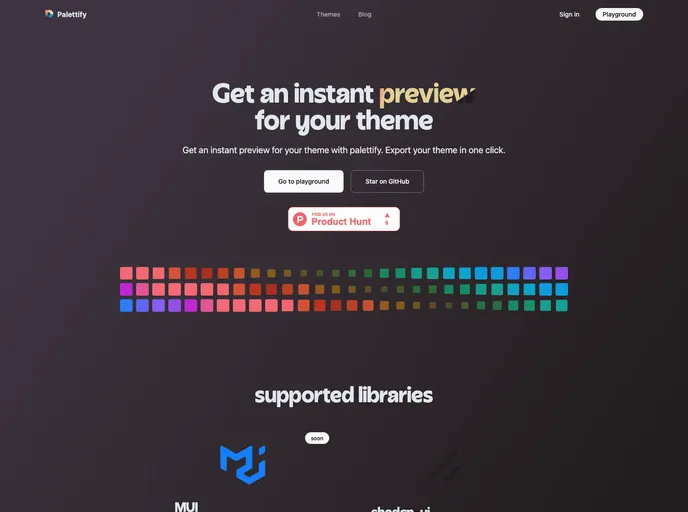



Beautiful themes for your website that you can copy and paste into your apps.
Overview:
The StargazersForksContributors app is a work in progress project that is being built in public. It is being developed using Next.js and React, with TypeScript and Tailwind CSS. The app aims to provide a platform for user management, theme customization, and saving of themes. The roadmap outlines the planned features and improvements for the app.
Features:
- Site structure: The app has a well-defined structure with separate pages for home, playground, themes, user management, saved themes, and account information.
- Playground page: The playground page allows users to customize and preview themes by selecting different styles, fonts, and gradients.
- User management: Users can create accounts, login, and manage their account information.
- Saved themes: Users can save their customized themes for future use.
- Landing view in preview: The app provides a preview of how the selected theme will look on the landing page.
- Integrate gradients: The app plans to integrate gradients into the theme customization options.
- Add fonts to theme model: The app will allow users to select and apply different fonts to their customized themes.
- Add multiple styles for components: Starting with the options of "New York" and "Default", the app plans to add custom styles for components.
Summary:
The StargazersForksContributors app is an ongoing project aiming to provide users with customization options for themes. Using Next.js, React, TypeScript, and Tailwind CSS, the app offers features such as user management, theme customization, and saving of themes. The roadmap outlines further improvements to be made, including the integration of gradients, font selection, and additional component styles. Contributions from the community are encouraged, and the app is distributed under the MIT License.
- Next.js
Next.js is a React-based web framework that enables server-side rendering, static site generation, and other powerful features for building modern web applications.
- React
React is a widely used JavaScript library for building user interfaces and single-page applications. It follows a component-based architecture and uses a virtual DOM to efficiently update and render UI components
- Material UI
material-ui adds classes to Tailwind CSS for all common UI components. Classes like btn, card, etc. This allows us to focus on important things instead of making basic elements for every project.
- Shadcn UI
Beautifully designed components that you can copy and paste into your apps. Accessible. Customizable. Open Source.
- Templates & Themes

A template or theme refers to a pre-designed layout or structure that provides a basic framework for building a specific type of application or website. It typically includes good design, placeholder content and functional features, allowing developers to customize and fill in the details according to their specific needs.
- Eslint

ESLint is a linter for JavaScript that analyzes code to detect and report on potential problems and errors, as well as enforce consistent code style and best practices, helping developers to write cleaner, more maintainable code.