
Vue3 Blocks Tree
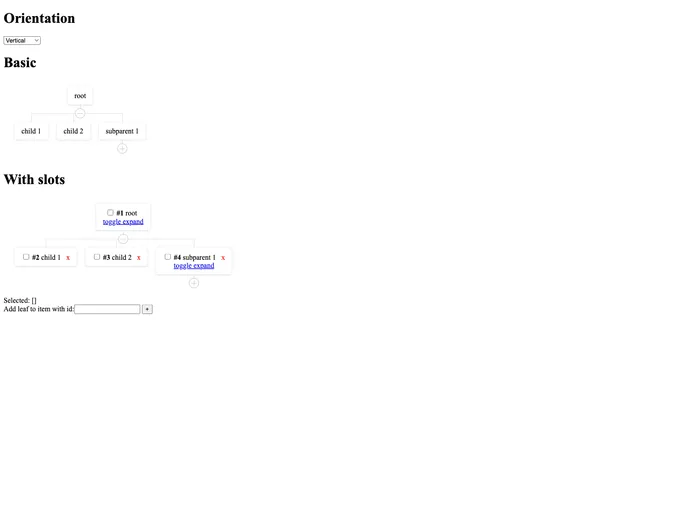



A vue3 block organization tree view component. Hierarchical horizontal or vertical tree
Overview
The vue3-blocks-tree is an efficient and versatile organizational structure tree view component built on Vue3.x. It offers a seamless way to visualize hierarchical data, providing essential features like event handling, slots for customization, and the ability to manipulate nodes easily. Whether you are developing a complex application or a simple site, this component enhances user interaction and data representation.
With its user-friendly design, vue3-blocks-tree not only supports horizontal layouts but also allows for collapsible nodes, making it a practical choice for displaying nested structures. Developers will appreciate the ease of integration and the power of customization options it provides.
Features
- Node Context: Offers an interface for node manipulation that includes methods like
isExpandedandtoggleExpandto manage node states dynamically. - Customizable Props: Allows you to configure labels, children, expand states, and unique keys, ensuring that you can tailor the structure to your data model.
- Flexible Label Width: Supports adjustable node label widths, making it easier to fit content according to design requirements.
- Collapsible Nodes: The
autocollapsablefeature lets child nodes collapse, which enhances user experience by reducing clutter. - Event Handling: Provides multiple events such as
node-click,node-mouseover, andnode-mouseout, allowing developers to implement interactive features based on user interactions. - Scoped Slots: Delivers powerful customization options through scoped slots, enabling developers to render node content and manage event handling efficiently.
- Horizontal Layout Support: Offers an aesthetic horizontal view mode that can be leveraged for unique presentations of data.
- MIT License: Based on an open-source licensing model, making it accessible for personal and commercial projects.
- Next.js
Next.js is a React-based web framework that enables server-side rendering, static site generation, and other powerful features for building modern web applications.
- Vue
Vue.js is a lightweight and flexible JavaScript framework that allows developers to easily build dynamic and reactive user interfaces. Its intuitive syntax, modular architecture, and focus on performance make it a popular choice for modern web development.
- LESS
Less CSS is a dynamic stylesheet language that extends the capabilities of CSS, allowing developers to write cleaner, more modular, and reusable stylesheets with features like variables, mixins, and nested rules.
- SCSS
SCSS is a preprocessor scripting language that extends the capabilities of CSS by adding features such as variables, nesting, and mixins. It allows developers to write more efficient and maintainable CSS code, and helps to streamline the development process by reducing repetition and increasing reusability.
- Typescript

TypeScript is a superset of JavaScript, providing optional static typing, classes, interfaces, and other features that help developers write more maintainable and scalable code. TypeScript's static typing system can catch errors at compile-time, making it easier to build and maintain large applications.
- Webpack

Webpack is a popular open-source module bundler for JavaScript applications that bundles and optimizes the code and its dependencies for production-ready deployment. It can also be used to transform other types of assets such as CSS, images, and fonts.