
Vue2react



:rabbit: Transform Vue component to React component
Overview
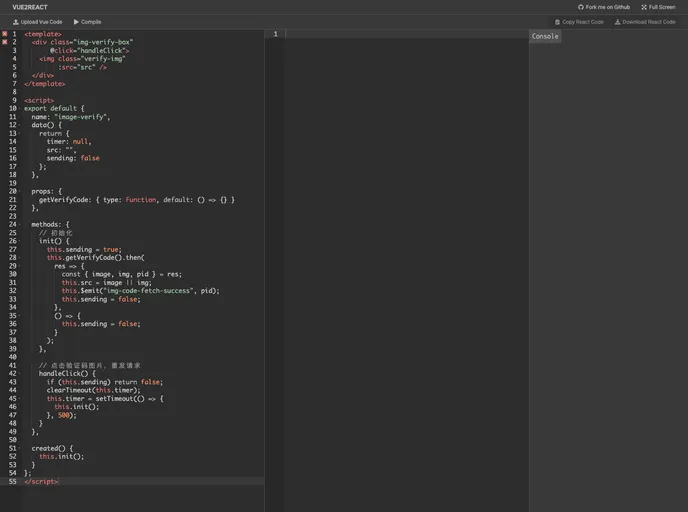
Vue2React is an innovative tool designed for developers looking to seamlessly transform Vue components into their React counterparts. With the increasing demand for compatibility between frameworks, this tool enhances productivity by simplifying the component migration process. Whether you choose to access it through a user-friendly web interface or a command-line interface (CLI), Vue2React provides multiple pathways to achieve optimal performance.
The tool is especially beneficial for developers working with Single File Components (SFC) and offers flexibility in its application. By utilizing the recommended Chrome browser for performance enhancements, users can ensure their transformations are executed efficiently. The CLI also provides a comprehensive set of features, making it adaptable for different coding environments and preferences.
Features
- Web Access: Easily accessible via a web interface, allowing users to transform components directly in their browser.
- CLI Functionality: Command-line interface support for developers who prefer terminal commands for efficiency.
- Single File Component Support: Capable of transforming .vue files, making it ideal for Vue developers transitioning to React.
- Responsive Performance: Optimized for use in Chrome, ensuring fast and efficient processing during transformation.
- Comprehensive Data Handling: Supports various data types including props, data, and computed properties for thorough component reconstruction.
- Lifecycle Hooks Support: Includes support for essential lifecycle hooks such as created, mounted, updated, and beforeDestroy.
- Directives Compatibility: Handles several Vue directives, enabling a seamless transition for templated elements into React.
- Special Attributes Management: Manages special attributes like key and ref, maintaining integrity during the transformation process.
- React
React is a widely used JavaScript library for building user interfaces and single-page applications. It follows a component-based architecture and uses a virtual DOM to efficiently update and render UI components
- Vue
Vue.js is a lightweight and flexible JavaScript framework that allows developers to easily build dynamic and reactive user interfaces. Its intuitive syntax, modular architecture, and focus on performance make it a popular choice for modern web development.
- LESS
Less CSS is a dynamic stylesheet language that extends the capabilities of CSS, allowing developers to write cleaner, more modular, and reusable stylesheets with features like variables, mixins, and nested rules.
- Typescript

TypeScript is a superset of JavaScript, providing optional static typing, classes, interfaces, and other features that help developers write more maintainable and scalable code. TypeScript's static typing system can catch errors at compile-time, making it easier to build and maintain large applications.
- Webpack

Webpack is a popular open-source module bundler for JavaScript applications that bundles and optimizes the code and its dependencies for production-ready deployment. It can also be used to transform other types of assets such as CSS, images, and fonts.