
Omedev
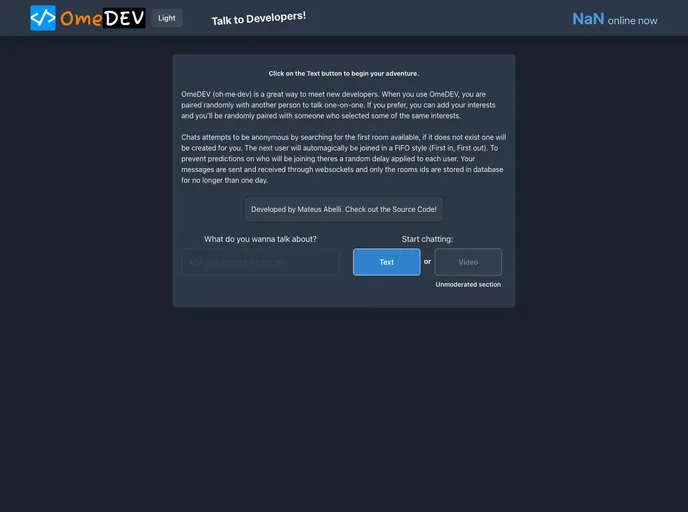



OmeDEV - Talk to Developers! This project is an Omegle clone that lets you chat with random developers.
Overview
OmeDEV provides an innovative way to connect with random developers through its unique chat interface. Designed as an Omegle clone, it focuses on creating an anonymous and random chatting experience by searching for available chat rooms or creating new ones as needed. This setup not only ensures a fresh experience with each connection but also implements a FIFO (First in, First out) system that enhances the smoothness of user interactions. The backend architecture uses websockets for real-time messaging while maintaining a user-friendly approach across devices.
This platform is built on a solid tech stack and serves as a learning project for its creator, showcasing an initiative to learn from building and creating together with the developer community. With features that prioritize anonymity and responsiveness, it's an exciting tool for those looking to engage with fellow developers in a casual, friendly environment.
Features
-
Anonymous Chat Rooms: Each connection is private, creating a comfortable space for developers to engage without revealing their identities.
-
FIFO User Joining: New users automatically join the chat room in a first-come, first-served manner, ensuring a fair and organized chatting experience.
-
Random Delay: To keep interactions unpredictable, users experience a random delay before being connected to each new chat, adding an element of surprise.
-
Responsive Design: The app is fully responsive and optimized for mobile devices, allowing users to chat conveniently from anywhere.
-
WebSocket Messaging: Messages are sent and received in real-time using websockets, providing a seamless communication experience.
-
Integrated with Modern Tech: Built using technologies like Next.js, TypeScript, and MongoDB Atlas, ensuring a robust and scalable application.
-
Community Contributions Welcome: The project invites developers to contribute, fostering a sense of community and collaboration among developers.
-
MIT License: The application is open-source and licensed under MIT, allowing anyone to use and modify it freely.
- Next.js
Next.js is a React-based web framework that enables server-side rendering, static site generation, and other powerful features for building modern web applications.
- React
React is a widely used JavaScript library for building user interfaces and single-page applications. It follows a component-based architecture and uses a virtual DOM to efficiently update and render UI components
- Chakra UI
Chakra UI is a popular open-source React component library that provides a set of accessible and customizable UI components to help developers create modern web applications.
- Prisma
Prisma is a server-side library that helps developers read and write data to the database in an intuitive, efficient and safe way.
- Fullstack

A fullstack boilerplate provides a starter application that includes both frontend and backend. It should include database, auth, payments, user roles and other backend services to build a fully featured saas or webapps.
- Eslint

ESLint is a linter for JavaScript that analyzes code to detect and report on potential problems and errors, as well as enforce consistent code style and best practices, helping developers to write cleaner, more maintainable code.
- Framer Motion

Alpine.js is a lightweight JavaScript framework that simplifies the process of creating dynamic, reactive user interfaces on the web. It uses a declarative syntax that offers a higher level of abstraction compared to vanilla JavaScript, while being more performant and easier to use than jQuery.
- Typescript

TypeScript is a superset of JavaScript, providing optional static typing, classes, interfaces, and other features that help developers write more maintainable and scalable code. TypeScript's static typing system can catch errors at compile-time, making it easier to build and maintain large applications.