
Formulus
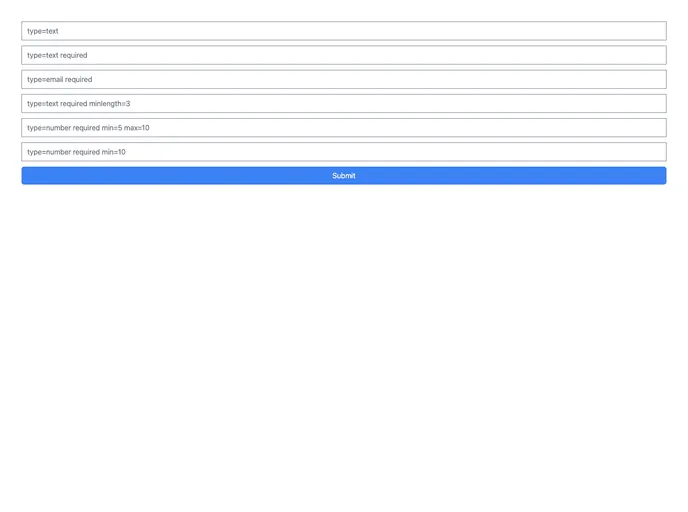

Client-side HTML form validations based on the browser HTML Form Validation API
Overview
Client-side HTML form validations are essential for enhancing user experience on websites. By utilizing the browser's built-in HTML Form Validation API, developers can ensure that users submit valid input before proceeding, which minimizes errors and improves data quality. This method adds a layer of instant feedback for users, alleviating the need for server-side checks upon form submission.
Implementing these validations not only streamlines the user interaction process but also adds a visually appealing aspect to forms, as users receive immediate prompts upon entry of invalid data. As a result, the time and effort spent on troubleshooting common input errors is significantly reduced.
Features
-
User-Friendly Feedback: Offers instant error messages or validation prompts, allowing users to correct their input without delay.
-
Built-in Browser Support: Utilizes the standardized HTML Form Validation API, ensuring compatibility across all modern browsers without the need for additional libraries.
-
Customizable Validation Messages: Developers can personalize validation error messages to provide clearer guidance, enhancing user understanding.
-
Multiple Input Types: Supports various input types, including text, email, URL, and number fields, ensuring comprehensive validation capabilities.
-
Required Field Validation: Easily flag fields as mandatory, guiding users to complete all necessary sections before submission.
-
Pattern Matching: Allows for advanced validation using regular expressions, ensuring specific formats and data integrity.
-
Accessibility Improvement: Enhances accessibility by providing clear and immediate feedback for users with different abilities, promoting inclusivity in form submissions.
- Ruby on Rails
Ruby on Rails, often referred to as Rails, is an open-source web application framework written in Ruby. Known for its convention over configuration and don't repeat yourself (DRY) principles, Rails simplifies and accelerates the development of database-backed web applications.
- Rollup

RollupJS is a popular and efficient JavaScript module bundler that takes the code from multiple modules and packages them into a single optimized file, minimizing the overall size of the application and improving its performance.
- Typescript

TypeScript is a superset of JavaScript, providing optional static typing, classes, interfaces, and other features that help developers write more maintainable and scalable code. TypeScript's static typing system can catch errors at compile-time, making it easier to build and maintain large applications.