
Exome
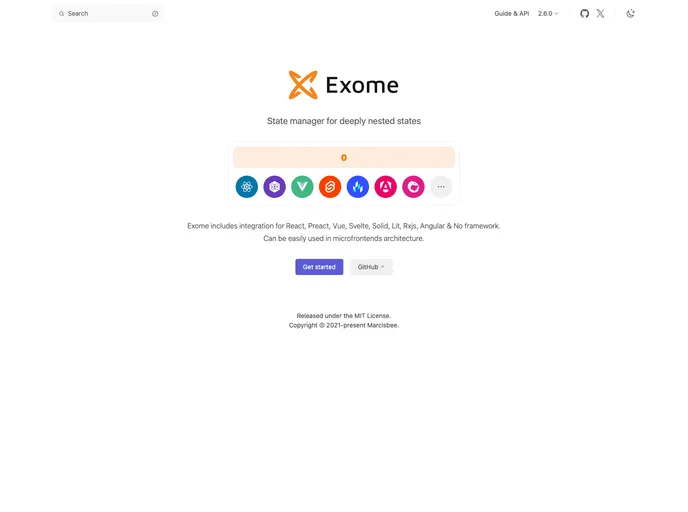



State manager for deeply nested states
Overview
Managing state in applications, especially those with deeply nested structures, can often prove to be a daunting task. With the rise of modern web frameworks, a robust solution is necessary to maintain efficiency and clarity. This state manager offers an elegant approach to handling state, integrating seamlessly with popular frameworks like React, Vue, and Angular, which provides developers with a versatile tool for their projects. Its lightweight and efficient design makes it an enticing option for those looking to enhance their state management strategies.
Furthermore, its compatibility with microfrontend architectures allows developers to implement it in a variety of settings, ensuring that it can adapt to different projects and requirements. This state manager seems poised to revolutionize the way we handle state in complex applications, presenting both a powerful and intuitive solution.
Features
- Small Size: At just 1 KB minizipped, this library is incredibly lightweight, making it fast to download and implement.
- High Performance: The library leverages a no-diffing approach for state changes, significantly increasing efficiency.
- Simplicity: By utilizing classes for state and methods for actions, it offers a straightforward approach to state management that is easy to grasp.
- Type Safety: Written in strict TypeScript, this library ensures type safety, enhancing the reliability of your application.
- Devtools Integration: It provides seamless integration with Redux devtools, making it easier to debug and manage state.
- Framework Compatibility: Works effortlessly with major frameworks like React, Vue, Svelte, Angular, and even without any framework, demonstrating its versatility.
- Zero Dependencies: The library does not rely on other packages, ensuring a clean and hassle-free integration into your project.
- React
React is a widely used JavaScript library for building user interfaces and single-page applications. It follows a component-based architecture and uses a virtual DOM to efficiently update and render UI components
- Svelte
Svelte is a modern front-end framework that compiles your code at build time, resulting in smaller and faster applications. It uses a reactive approach to update the DOM, allowing for high performance and a smoother user experience.
- Vue
Vue.js is a lightweight and flexible JavaScript framework that allows developers to easily build dynamic and reactive user interfaces. Its intuitive syntax, modular architecture, and focus on performance make it a popular choice for modern web development.
- Typescript

TypeScript is a superset of JavaScript, providing optional static typing, classes, interfaces, and other features that help developers write more maintainable and scalable code. TypeScript's static typing system can catch errors at compile-time, making it easier to build and maintain large applications.