
Automad
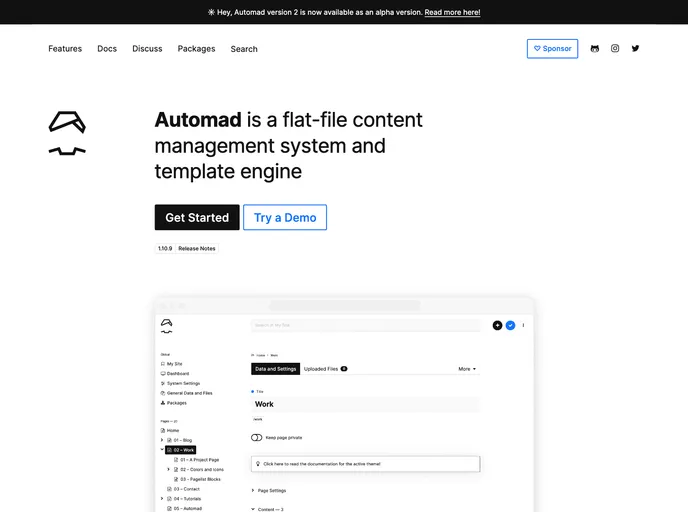

A flat-file content management system and template engine
Overview
Automad is a flat-file content management system and template engine that is currently in active development for version 2. The update will include a full rewrite of the entire application, including the backend, frontend, standard theme, and blocks. The goal is to incorporate feature requests and resolve open issues before the release. Existing websites and extensions from version 1 will continue to work with version 2, with only minor breaking changes communicated in the release notes. The new version will have a dashboard written in TypeScript and will no longer have jQuery and UIkit as dependencies. The backend will require PHP 8.0 or newer. Automad is an open-source project and there is no fixed release date for version 2.
Features
- Flat-file content management system
- Template engine
- Full rewrite for version 2
- Dashboard written in TypeScript
- No more dependencies on jQuery and UIkit
- Compatible with existing websites and extensions from version 1
- Minor breaking changes communicated in release notes
- Requires at least PHP 8.0 for backend
Composer
The fastest way to install Automad is by using Composer. Follow the provided guide for the installation process.
Docker
Automad can also be run in a Docker container with Nginx and PHP 8. The first run of the image will automatically create a new user account for the Automad dashboard, and the account details will be logged by the container. Access your new site by navigating to localhost.
Manual Download
Alternatively, Automad can be installed manually. No specific instructions are provided, so it's assumed that the user would need to refer to the documentation or seek assistance from the community.
Summary
Automad is a flat-file content management system and template engine that is currently in active development for version 2. The update includes a full rewrite of the application and introduces new features while addressing existing issues. The new version will have a TypeScript dashboard and no longer depend on jQuery and UIkit. Existing websites and extensions from version 1 will remain compatible with version 2, with only minor breaking changes. Automad can be installed using Composer, Docker, or manually. It is an open-source project with no fixed release date for version 2.
- LESS
Less CSS is a dynamic stylesheet language that extends the capabilities of CSS, allowing developers to write cleaner, more modular, and reusable stylesheets with features like variables, mixins, and nested rules.
- Postcss

PostCSS is a popular open-source tool that enables web developers to transform CSS styles with JavaScript plugins. It allows for efficient processing of CSS styles, from applying vendor prefixes to improving browser compatibility, ultimately resulting in cleaner, faster, and more maintainable code.
- Typescript

TypeScript is a superset of JavaScript, providing optional static typing, classes, interfaces, and other features that help developers write more maintainable and scalable code. TypeScript's static typing system can catch errors at compile-time, making it easier to build and maintain large applications.