
Angular Rails
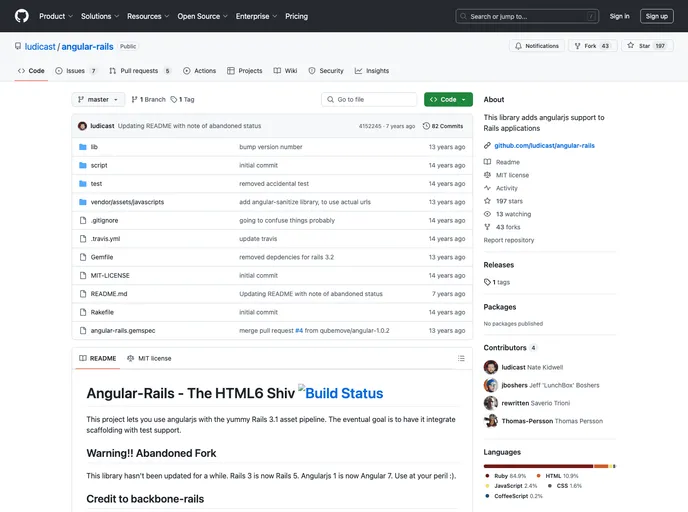
This library adds angularjs support to Rails applications
Overview
Angular-Rails serves as a bridge between AngularJS and the Rails 3.1 asset pipeline, allowing developers to integrate these two powerful technologies seamlessly. While the project has not been updated in recent times, its intention was to facilitate development by incorporating scaffolding along with test support. This fusion aims to reduce friction between the front and back end of applications, harnessing the Rails way while encourage cleaner, less error-prone code.
Though it’s essential to note that the library is an abandoned fork, it was initially inspired by the backbone-rails project. Despite being outdated, it still offers a glimpse into the integration of modern JavaScript frameworks with traditional Ruby on Rails applications, catering to developers who are willing to explore legacy code.
Features
-
Seamless Integration: Angular-Rails smooths the integration of AngularJS into a Rails 3.1 asset pipeline, providing a coherent structure for organizing frontend code.
-
Rails-Friendly Syntax: Utilizing Coffeescript, this library emphasizes reduced lines of code, which closely aligns with Ruby on Rails principles and enhances maintainability.
-
Installation Simplicity: A straightforward installation process includes bundling the gem and running a generator command to automate setup, easing the onboarding experience.
-
SCSS and HAML Templates: The library generates a templates directory allowing the use of HAML and other templating languages for Angular views, promoting a flexible front-end architecture.
-
Basic Generators: It includes a controller generator that sets up basic scaffolding for Angular controllers, supporting the rapid development of client-side code.
-
DRY Principle Focus: The addition of the angle-up file intends to maintain the DRY (Don't Repeat Yourself) principle in Angular applications, streamlining code practices.
-
Potential for RESTful Design: With loosely defined requirements for RESTful controllers, Angular-Rails encourages the smooth interchange of data between the frontend and backend, enhancing application performance.