
Next Export Api
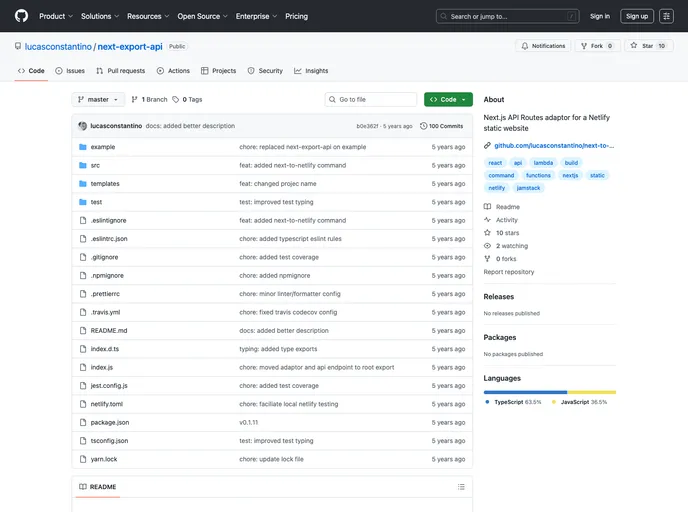



Next.js API Routes adaptor for a Netlify static website
Overview
The Next Export API is an essential tool for developers looking to utilize Next.js API Routes on statically exported websites deployed through Netlify. This solution addresses the limitations of using Next.js API Routes in exported projects, making it easier to integrate serverless functions with a streamlined approach. For those who want to leverage the power of Next.js while enjoying the benefits of a static site deployment on Netlify, this tool provides a practical and effective solution.
With a year of inspiration from previous projects like next-on-netlify and next-aws-lambda, the Next Export API focuses specifically on the intricacies of Next.js and its unique export capabilities. This means that it effectively bridges the gap between creating API endpoints in Next.js and deploying them successfully in a serverless environment.
Features
-
Easy Integration: Seamlessly incorporate Next.js API Routes into statically exported sites on Netlify with straightforward installation steps.
-
Production Ready: Designed as a production dependency, ensuring it works effectively in real-world deployment scenarios.
-
Automated File Creation: Automatically generates appropriate files for each API route during the export process, reducing manual setup time.
-
Redirects Configuration: Creates necessary
_redirectsrules for all API routes, ensuring proper mapping to Netlify’s function calls. -
Adaptability: Capable of reading page manifests from the Next.js build, enabling customized configurations for different project needs.
-
Serverless-Compatible: Utilizes well-supported serverless-http for executing Next.js functions, ensuring performance and compatibility with AWS infrastructure.
-
Easy Setup: The configuration through the
netlify.tomlfile is simple, allowing for quick deployment adjustments as needed.
- Express
Express.js is a simple Node.js framework for single, multi-page, and hybrid web applications.
- Next.js
Next.js is a React-based web framework that enables server-side rendering, static site generation, and other powerful features for building modern web applications.
- React
React is a widely used JavaScript library for building user interfaces and single-page applications. It follows a component-based architecture and uses a virtual DOM to efficiently update and render UI components
- Eslint

ESLint is a linter for JavaScript that analyzes code to detect and report on potential problems and errors, as well as enforce consistent code style and best practices, helping developers to write cleaner, more maintainable code.
- Netlify

Netlify is a cloud-based web development platform that provides a range of tools and services to help developers build, deploy, and manage modern web applications. It offers features such as continuous deployment, serverless functions, and CDN hosting, making it an ideal platform for building fast, scalable, and secure websites.
- Typescript

TypeScript is a superset of JavaScript, providing optional static typing, classes, interfaces, and other features that help developers write more maintainable and scalable code. TypeScript's static typing system can catch errors at compile-time, making it easier to build and maintain large applications.