
Django Pgschemas
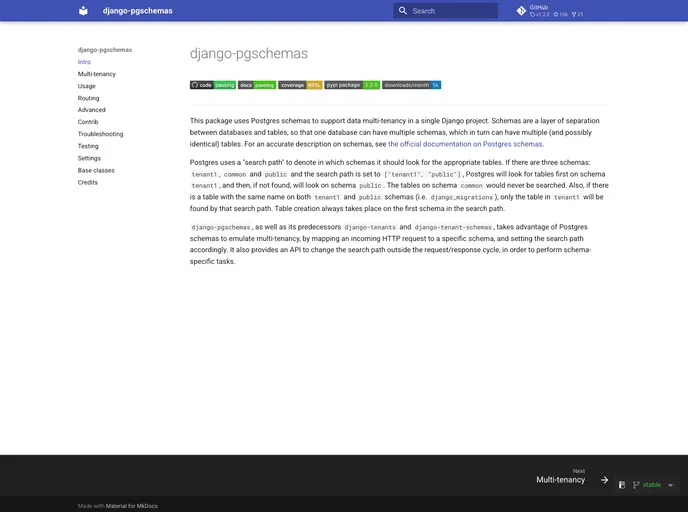

Django multi-tenancy through Postgres schemas
Overview
Django-pgschemas is an innovative solution that utilizes Postgres schemas to enable data multi-tenancy within a single Django project. By forking django-tenants, this package introduces distinct structures for handling static and dynamic tenants, providing greater flexibility and efficiency in managing multiple tenants under one application framework. This setup is particularly beneficial for developers looking to streamline their applications while maintaining separation of data for different client tenants.
One of the standout features of django-pgschemas is its robust routing options which allow tenants to be distinguished easily, whether through subdomains or subfolders. This tailored approach not only simplifies management but also enhances performance by leveraging the capabilities of Postgres schemas, making it a great choice for projects that require intricate data segregation.
Features
-
Static and Dynamic Tenants: Facilitates the management of static tenants with their own applications and URL configurations, alongside dynamic tenant options for added flexibility.
-
Tenant Routing: Offers the ability to route tenants via URL, utilizing either subdomains or subfolders, granting developers control over data accessibility.
-
Shared Public Schema: Ensures that the public schema is reserved for shared data across all tenants, enhancing data protection and organization.
-
Management Commands: Supports execution of management commands across multiple schemas using wildcards, allowing for efficient operations both sequentially and in parallel.
-
Advanced Multithreading: Enables multithreading capabilities for managing schemas, boosting performance and efficiency during data processing tasks.
-
Credits and Contributions: Recognizes contributions from notable developers who have enhanced the functionality and stability of the package, ensuring a well-supported development environment.
- Django
Django is a high-level Python web framework that encourages rapid development and clean, pragmatic design. It follows the model-view-controller (MVC) architectural pattern, providing an extensive set of built-in tools and conventions to streamline the creation of robust and scalable web applications.
- Fullstack

A fullstack boilerplate provides a starter application that includes both frontend and backend. It should include database, auth, payments, user roles and other backend services to build a fully featured saas or webapps.