
Next Email Client
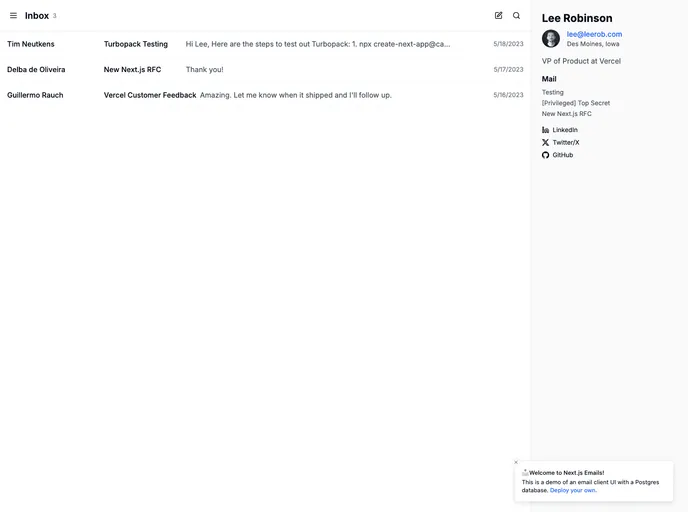


An email client built with the Next.js App Router and Postgres.
Overview
The Next.js Email Client is an innovative and simple email application that leverages the powerful capabilities of Next.js and Postgres. Designed to showcase the App Router's features, this email client offers a seamless experience for users looking to navigate their email with ease. With a focus on speed and efficiency, it enables users to manage their emails while maintaining scroll positions and avoiding the need for JavaScript in form submissions.
By integrating tools like Tailwind CSS, TypeScript, and React Aria Components, this email client brings a modern design approach along with functional robustness. While still in development, it sets the stage for a robust email management tool.
Features
- Column Layout Navigation: Navigate between routes in a column layout while retaining your scroll position for smoother usability.
- Progressive Enhancement: Submit forms even when JavaScript is disabled, ensuring accessibility across various user environments.
- Fast Route Navigation: Take advantage of prefetching and caching for extremely quick transitions between routes.
- URL State Retention: Keep your UI position intact on reloads, enhancing user experience during navigation.
- Postgres Database Compatibility: Utilize any Postgres database for easy data management and integration with existing systems.
- User Management Capabilities: Users can send and receive emails with multiple folders, enhancing their organizational capabilities.
- Sample Data Setup: Easily set up the project with built-in schema and sample data to jumpstart development.
Overall, the Next.js Email Client is a compelling solution for those looking to harness the power of Next.js in building a modern and efficient email client.
- Next.js
Next.js is a React-based web framework that enables server-side rendering, static site generation, and other powerful features for building modern web applications.
- React
React is a widely used JavaScript library for building user interfaces and single-page applications. It follows a component-based architecture and uses a virtual DOM to efficiently update and render UI components
- Tailwind
Tailwind CSS is a utility-first CSS framework that provides pre-defined classes for building responsive and customizable user interfaces.
- Geist UI
Geist UI is a modern, minimalist React component library inspired by Vercel's design language. It provides clean, elegant components with a focus on simplicity and developer experience, perfect for building modern web applications.
- React Aria
Craft world-class accessible components with custom styles. Over 40 components with built-in behavior, adaptive interactions, top-tier accessibility, and internationalization out of the box, ready for your styles.
- Fullstack

A fullstack boilerplate provides a starter application that includes both frontend and backend. It should include database, auth, payments, user roles and other backend services to build a fully featured saas or webapps.
- Postcss

PostCSS is a popular open-source tool that enables web developers to transform CSS styles with JavaScript plugins. It allows for efficient processing of CSS styles, from applying vendor prefixes to improving browser compatibility, ultimately resulting in cleaner, faster, and more maintainable code.
- Typescript

TypeScript is a superset of JavaScript, providing optional static typing, classes, interfaces, and other features that help developers write more maintainable and scalable code. TypeScript's static typing system can catch errors at compile-time, making it easier to build and maintain large applications.
- Zod

Zod is a TypeScript-first schema declaration and validation library. It allows you to define schemas that can validate data at runtime while providing excellent TypeScript inference, making it perfect for API validation, form validation, and type-safe data handling.