
Daily Purpose 3625
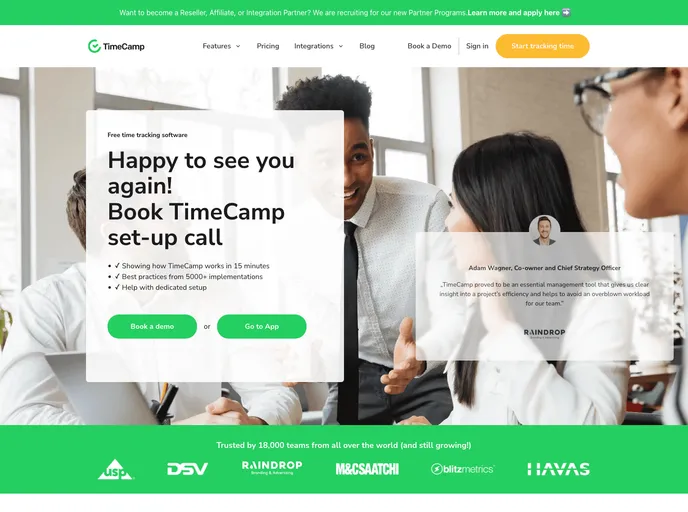


Time-camp_Clone its a website which can check your system efficiency and give suggestion for your system to improve its efficency .Its also help in time management and provide suggestion according to your previous work and performence
Overview
This project is a clone of the TimeCamp website, developed by a group of 5 members during their construct week in Masai School. TimeCamp is a web-based application launched in 2009 by Kamil Rudnicki, aimed at tracking the activity of computer users and assisting in time tracking, project management, and work effectiveness measurement. The clone website was completed within 4 days.
Features
- Homepage/Landing Page: Well-designed and user-friendly landing page to provide an appealing initial impression.
- User Authentication: Sign-up and log-in options for users using Google and Facebook authentication, implemented using backend and MongoDB.
- User-friendly Navigation: A navigation bar that allows users to easily view and explore different sections of the website.
- Pricing Page: Presents different price ranges from free to enterprise, providing users with the necessary information to choose a suitable plan.
- Demo Page: Offers a brief demo to help users get acquainted with the website before starting to use it.
- Features Page: Provides an overview of all the features that the application offers.
- Integrations Page: Offers information about the various integrations available with the TimeCamp application.
- Timersheet: Well-designed timersheet with a timer function that starts once a user logs in, tracking the user's computer usage and tasks.
Summary
The TimeCamp Clone project is a replica of the TimeCamp website developed within a short time frame during Masai School's construct week. It includes various features such as a user-friendly landing page, authentication using Google and Facebook, a well-designed navigation bar, pricing options, a demo page, feature overview, integration information, and a timersheet for tracking computer usage. The project was implemented using HTML5, CSS3, React.js, Chakra-UI, Node.js, Express, MongoDB, React-router-dom, Google Integration, Facebook Integration, and Redux.
- HTML
HTML templates are pre-designed and pre-built web pages that can be customized and used as a basis for building websites. They often include common elements such as headers, footers, menus, and content sections, and can be easily edited using HTML and CSS to fit specific branding and content needs.
- React
React is a widely used JavaScript library for building user interfaces and single-page applications. It follows a component-based architecture and uses a virtual DOM to efficiently update and render UI components
- Chakra UI
Chakra UI is a popular open-source React component library that provides a set of accessible and customizable UI components to help developers create modern web applications.
- Redux
Redux is a state management library for JavaScript apps that provides a predictable and centralized way to manage application state. It enables developers to write actions and reducers that update the state in response to user interactions, server responses, and other events, and can be used with a variety of front-end frameworks and back-end technologies.