
Alkali
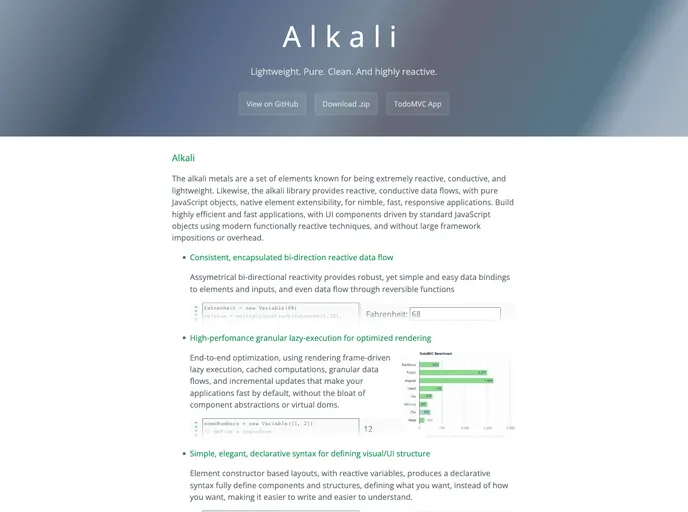
Alkali is library for functional reactive data flows that drive native-based UI elements
Overview
Alkali is an innovative JavaScript package crafted for developers aiming to create efficient, reactive data flows that seamlessly integrate with native HTML elements. Inspired by alkali metals, known for their reactivity and conductivity, this library stands out as a lightweight (only 20KB gzipped) and dependency-free solution for building reactive user interfaces without the bulk of larger frameworks. Its design centers around a functional reactive programming model that ensures optimized performance and scalability, making it perfect for modern web applications.
With Alkali, developers can leverage pure JavaScript objects to create dynamic UIs effortlessly. The package utilizes a cache and invalidation system for rendering, which allows applications to remain swift and responsive, a crucial factor in today’s fast-paced development environment. Whether building simple components or complex interactive applications, Alkali provides the tools necessary to achieve impressive results.
Features
-
Lightweight and Dependency-Free: At just 20KB gzipped, Alkali stands on its own without the need for additional libraries, ensuring quick load times and less overhead.
-
True Functional Reactive Architecture: Utilizes a cache and invalidation-based system for rendering, ensuring optimized performance and efficient data flow.
-
Reactive Variables: Core to Alkali are its "Variables," which store source data and respond to changes, enabling seamless updates in UI components.
-
Native DOM Support: Directly interacts with native HTML elements, allowing developers to create reactive UIs using standard web technologies.
-
Modern JavaScript Features: Designed to leverage the latest JavaScript capabilities, enhancing usability and developer experience without sacrificing performance.
-
Custom Component Creation: Alkali enables the creation and extension of web components and custom elements, providing flexibility in building complex UIs.
-
Efficient Event Handling: With built-in event listeners and binding mechanisms, managing user interactions becomes straightforward and efficient.
-
Cross-Browser Compatibility: Alkali is built to work across various browsers, ensuring consistency in behavior and performance regardless of user environment.
- Typescript

TypeScript is a superset of JavaScript, providing optional static typing, classes, interfaces, and other features that help developers write more maintainable and scalable code. TypeScript's static typing system can catch errors at compile-time, making it easier to build and maintain large applications.
- Web Components

Web components provide a way to create reusable, encapsulated UI components using standard web technologies such as HTML, CSS, and JavaScript. They allow developers to create complex UI components that can be easily shared across multiple projects and frameworks. Web components are built using four main specifications: Custom Elements, Shadow DOM, HTML Templates, and ES Modules.
- Webpack

Webpack is a popular open-source module bundler for JavaScript applications that bundles and optimizes the code and its dependencies for production-ready deployment. It can also be used to transform other types of assets such as CSS, images, and fonts.