
Salt Ds
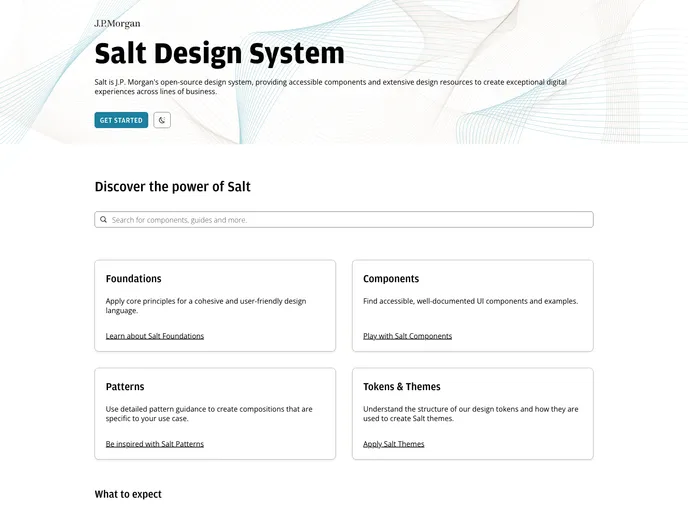



React UI components built with a focus on accessibility, customization and ease-of-use
Overview
Salt is an innovative suite of UI components designed for modern web development, offering a comprehensive theming system that allows for both default and customizable themes. With its appealing aesthetics, available in light and dark modes, Salt not only meets the visual demands of contemporary applications but also provides support for various UI densities. The framework emphasizes performance and accessibility by adhering to WCAG 2.1 guidelines, ensuring that your applications are not only beautiful but also user-friendly for everyone.
What's particularly compelling about Salt is its modular architecture; it comprises several packages that cater to different needs, ensuring a lightweight and efficient development process. Whether you're looking for stable components, in-development features, or stylish icons, Salt has you covered.
Features
- Comprehensive UI Controls: Offers a wide range of commonly-used controls for seamless application development.
- Flexible Theming System: Easily create multiple theme variations or substitute alternate themes to match your brand identity.
- Dark and Light Variants: Choose between aesthetically pleasing light and dark themes to enhance user experience.
- Accessibility Compliance: Fully compliant with WCAG 2.1 standards, ensuring your applications are accessible to all users.
- Lightweight and Performant: Designed to maintain high performance while keeping your application size manageable.
- Minimal Third-party Dependencies: Reduces bloat and potential compatibility issues by minimizing reliance on external libraries.
- Active Development Environment: Utilize beta components from the @salt-ds/lab package to stay ahead with new features before they stabilize.
- SVG-based Icons: Access a collection of scalable icons to enhance your application's visual appeal and interface clarity.
- React
React is a widely used JavaScript library for building user interfaces and single-page applications. It follows a component-based architecture and uses a virtual DOM to efficiently update and render UI components
- TanStack
TanStack is a collection of high-quality, framework-agnostic libraries including TanStack Query for data fetching, TanStack Router for routing, TanStack Table for tables, and more. These tools provide powerful, type-safe solutions for common web development challenges.
- Vite
Vite is a build tool that aims to provide a faster and leaner development experience for modern web projects
- Rollup

RollupJS is a popular and efficient JavaScript module bundler that takes the code from multiple modules and packages them into a single optimized file, minimizing the overall size of the application and improving its performance.
- Storybook
Storybook is a tool for developing and testing UI components in isolation. It provides a sandbox environment where you can experiment with different props and states to see how your component responds.
- Stylelint
Stylelint is a modern linter for CSS that helps you avoid errors and enforce consistent styling conventions. It provides rules for detecting errors and warnings, and can be configured to match your specific project's requirements.
- Typescript

TypeScript is a superset of JavaScript, providing optional static typing, classes, interfaces, and other features that help developers write more maintainable and scalable code. TypeScript's static typing system can catch errors at compile-time, making it easier to build and maintain large applications.
- Yup
Yup is a schema builder for runtime value parsing and validation. It provides a declarative way to define validation schemas with support for complex nested objects, array validation, and custom validation rules. Often used with Formik for form validation.