
Nextjs Dashboard
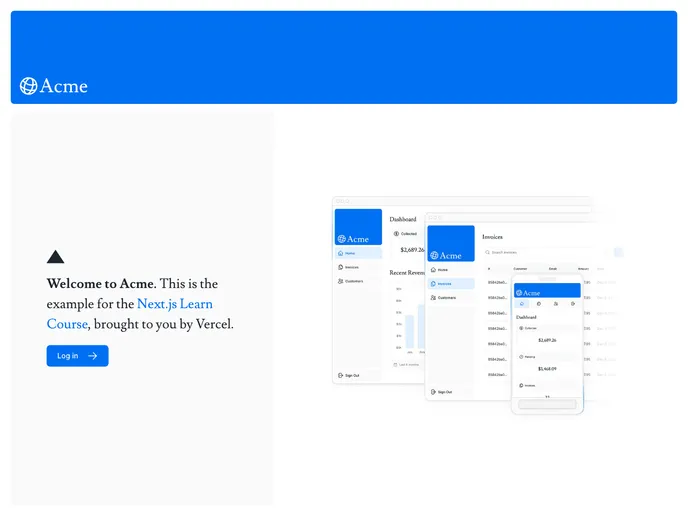


An admin dashboard built with Next.js and Tailwind css
Overview
The Next.js Admin Dashboard is an impressive tool designed for developers seeking to create a robust and visually appealing admin interface. Leveraging the capabilities of the Next.js framework along with Tailwind CSS, this dashboard streamlines the development process while providing a sleek user experience. With a focus on simplicity and efficiency, it's an ideal choice for both seasoned developers and those new to web development.
Setting up this dashboard is relatively straightforward, thanks to clear instructions on prerequisites like Node.js and npm or yarn. Additionally, the detailed process for integrating a Vercel Postgres database helps ensure that users can efficiently manage their data while maintaining a beautifully designed interface.
Features
- Built with Next.js: Utilizes the power of the Next.js framework for server-side rendering and static site generation, enhancing performance and SEO.
- Tailwind CSS Integration: Offers a customizable design system for easy styling, allowing developers to quickly build responsive layouts.
- Easy Database Setup: Simplifies the process of connecting to a Vercel Postgres database with step-by-step instructions for creation and connection.
- Environment Configuration: Easy setup of environment variables through a straightforward .env file, facilitating secure configurations for your project.
- Seeding Feature: Quickly populate your database with initial data to get your application up and running, saving time during development.
- Local Server Management: Provides simple commands to start your local server, making it convenient to test and debug your application.
- Open for Contributions: Encourages community involvement by welcoming contributions, fostering a collaborative development environment.
- Next.js
Next.js is a React-based web framework that enables server-side rendering, static site generation, and other powerful features for building modern web applications.
- React
React is a widely used JavaScript library for building user interfaces and single-page applications. It follows a component-based architecture and uses a virtual DOM to efficiently update and render UI components
- Tailwind
Tailwind CSS is a utility-first CSS framework that provides pre-defined classes for building responsive and customizable user interfaces.
- Eslint

ESLint is a linter for JavaScript that analyzes code to detect and report on potential problems and errors, as well as enforce consistent code style and best practices, helping developers to write cleaner, more maintainable code.
- Postcss

PostCSS is a popular open-source tool that enables web developers to transform CSS styles with JavaScript plugins. It allows for efficient processing of CSS styles, from applying vendor prefixes to improving browser compatibility, ultimately resulting in cleaner, faster, and more maintainable code.
- Typescript

TypeScript is a superset of JavaScript, providing optional static typing, classes, interfaces, and other features that help developers write more maintainable and scalable code. TypeScript's static typing system can catch errors at compile-time, making it easier to build and maintain large applications.
- Zod

Zod is a TypeScript-first schema declaration and validation library. It allows you to define schemas that can validate data at runtime while providing excellent TypeScript inference, making it perfect for API validation, form validation, and type-safe data handling.