
Bugbank UI
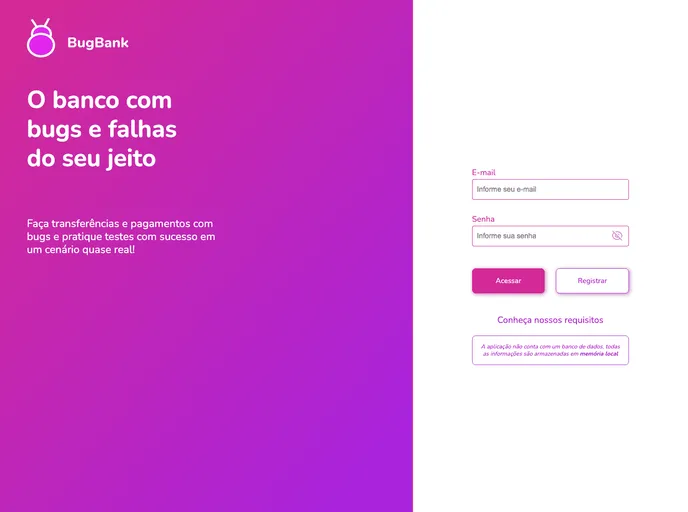


O banco com bugs e falhas do seu jeito
Overview
Bug Bank is an innovative tool designed for developers and testers who want to enhance their skills in test planning and automation. It serves as a hands-on application that simulates real-world projects, making it an excellent choice for those looking to practice identifying and managing bugs and issues in software. The concept behind Bug Bank revolves around creating a practical environment where users can explore, experiment, and learn through engagement with its features.
The platform is perfect for both beginners and seasoned professionals. With the interface inspired by real projects, it encourages users to dive deep into the intricacies of software testing in a way that is both engaging and effective. Whether you are preparing for a career in software testing or looking to refine your existing skills, Bug Bank offers a fun and interactive approach to learning.
Features
-
Realistic Bug Simulation: Bug Bank provides a realistic environment that mimics projects with common bugs and failures, allowing for effective practice in test planning.
-
Test Automation: Users can hone their automation skills through well-defined scenarios that simulate real-life software issues, aiding in quick identification and resolution.
-
Easy Setup: The project setup is straightforward, enabling users to get started quickly with a simple cloning process and commands for dependency installation.
-
Local Development Server: Once set up, Bug Bank runs seamlessly on a local server (localhost:3000), providing instant feedback and interactivity.
-
User-Centric Design: The application is designed with users in mind, ensuring an engaging experience filled with opportunities to learn and apply testing concepts.
-
Community Contribution: Bug Bank encourages contributions from users, making it a collaborative platform where individuals can share their insights and improvements.
-
Supportive Resources: Comprehensive documentation and resources are available, helping users navigate the platform and maximize their learning potential.
- Next.js
Next.js is a React-based web framework that enables server-side rendering, static site generation, and other powerful features for building modern web applications.
- React
React is a widely used JavaScript library for building user interfaces and single-page applications. It follows a component-based architecture and uses a virtual DOM to efficiently update and render UI components
- Styled Components
Styled Components is a popular library for styling React components using CSS syntax. It allows you to write CSS in your JavaScript code, making it easier to create dynamic styles that are specific to each component.
- Eslint

ESLint is a linter for JavaScript that analyzes code to detect and report on potential problems and errors, as well as enforce consistent code style and best practices, helping developers to write cleaner, more maintainable code.
- Typescript

TypeScript is a superset of JavaScript, providing optional static typing, classes, interfaces, and other features that help developers write more maintainable and scalable code. TypeScript's static typing system can catch errors at compile-time, making it easier to build and maintain large applications.
- React Hook Form

React Hook Form is a performant, flexible, and extensible form library for React with easy validation. It reduces re-renders and improves performance by using uncontrolled components and native HTML validation, making form handling simple and efficient.
- Yup
Yup is a schema builder for runtime value parsing and validation. It provides a declarative way to define validation schemas with support for complex nested objects, array validation, and custom validation rules. Often used with Formik for form validation.