
Practical Astronomy Python
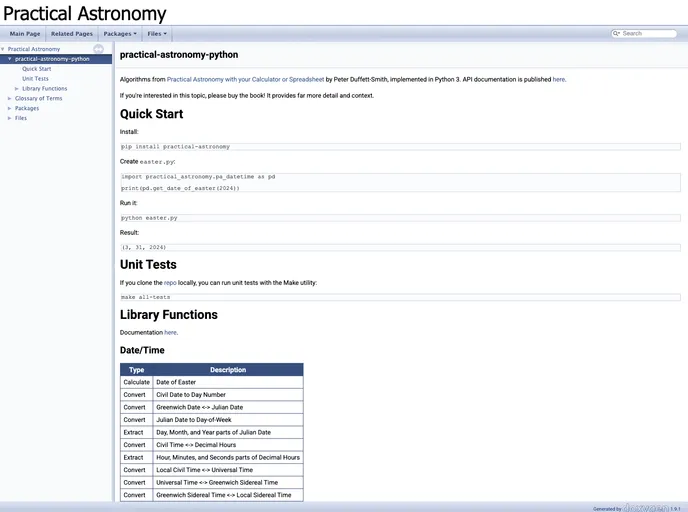
Implementation of algorithms from "Practical Astronomy with your Calculator or Spreadsheet"
Overview
Practical Astronomy with Python is an innovative tool that seamlessly integrates astronomy algorithms into the Python programming environment, making complex calculations more accessible for both amateur astronomers and professionals. Designed by Peter Duffett-Smith, this package allows users to perform a wide range of astronomical calculations—from determining the date of Easter to calculating the positions of celestial bodies with remarkable accuracy. The combination of astronomy with programming provides enthusiasts a deeper understanding and an opportunity to engage with the subject matter in a hands-on way.
The wealth of functionalities included in this project extends beyond mere calculations. It serves as a comprehensive library that offers users various methods and tools for converting date formats, calculating celestial coordinates, and determining significant astronomical events such as eclipses and moon phases. Whether you are a programmer looking to enrich your understanding of space or an astronomer seeking reliable data, this library could be an essential addition to your toolkit.
Features
- Date of Easter Calculation: Accurately determines the date of Easter using algorithms.
- Coordinate Conversion: Easily converts between different celestial coordinate systems, such as equatorial and galactic coordinates.
- Celestial Events: Calculates rising and setting times for objects as well as the occurrence of eclipses.
- Planetary Positions: Provides both approximate and precise positions of planets, including their visual aspects and significant data about comets.
- Moon Calculations: Calculates the Moon’s phase, position, and local rise/set times, along with distances and angular sizes.
- Sun Calculations: Offers detailed solar data, such as sunrise/sunset times, solar elongation, and the equation of time.
- Unit Testing: Includes unit tests, ensuring accuracy and reliability of the calculations.
- Comprehensive Documentation: Well-structured documentation guides users through installation, usage, and troubleshooting, making it easy to get started.